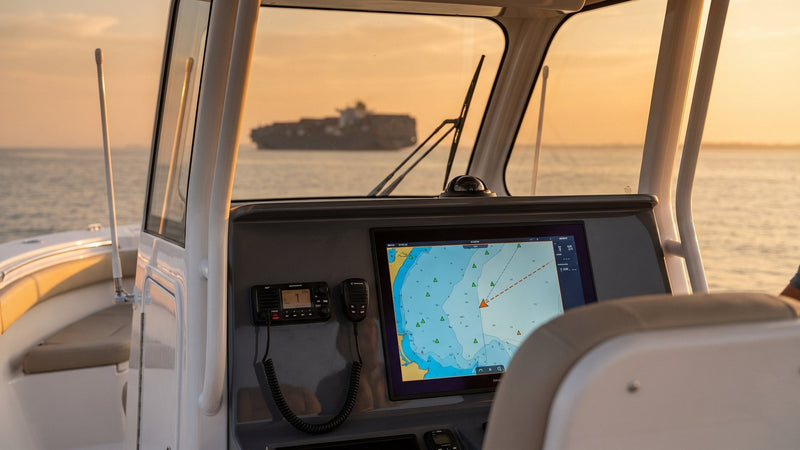
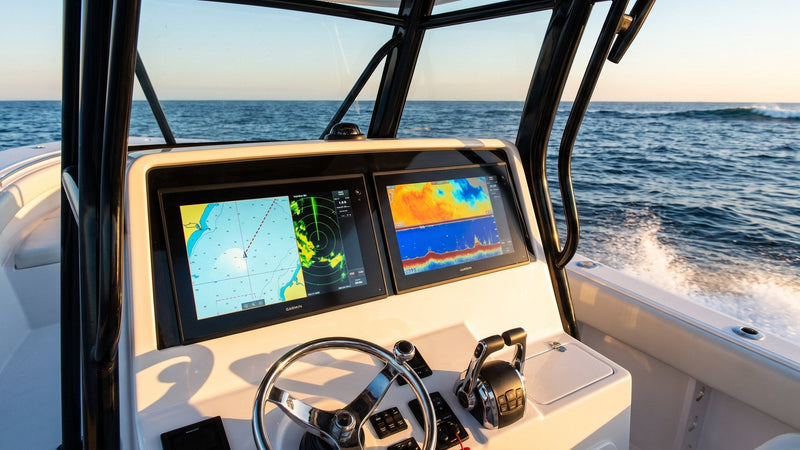
Most 25-foot center consoles don't get ruined by a bad chartplotter. They get ruined by a good chartplotter bought for a dash that can't hold it, wired to a battery that can't feed it, with no room left for the radio.
We see it every spring: a 16-inch display ordered for a console with 14 inches of usable width between the compass and the trim gauges. Now it's a fiberglass job.
So here are three complete 25 foot center console electronics packages, priced at roughly $3,000, $7,000 and $14,000 with current NVN Marine prices, built around what actually fits on a boat this size. We've installed versions of all three.
What a 25-foot center console actually needs
A 25-footer is big enough to run 30 miles offshore on a good day and small enough that the console is a single-person helm with maybe 24 to 30 inches of flat dash face. Most have one or two outboards, a start and a house battery, and hydraulic steering.
That boat needs five things, in this order:
- A multifunction display (MFD) with chart and sonar.
- A transducer that reads bottom at cruising speed, not just at idle.
- A fixed-mount VHF with DSC and a proper 8-foot antenna.
- AIS, at minimum receive, ideally transmit.
- A NMEA 2000 backbone so all of the above share GPS, heading, and targets.
Radar is sixth, and it's the one people argue about. Autopilot is seventh.
We built all three around Garmin because one brand covers the MFD, radar, autopilot and VHF at every price tier here, with no adapters. Raymarine and Simrad packages work too; the logic carries over.
Package 1: The $3,000 build (chart, sonar, VHF, AIS receive)
For inshore and nearshore running, rarely in fog, with room to grow.
- Garmin GPSMAP 943xsv 9" Combo GN+ $1,599.99
- Garmin GT56UHD-TM transom mount transducer $479.99
- Standard Horizon GX2400B Matrix VHF with AIS, GPS and NMEA 2000 $499.99
- Shakespeare 5225-XT 8' Galaxy VHF antenna, 6 dB $265.99
- Garmin NMEA 2000 Starter Kit $99.89
Package total: $2,945.85
Why not the cheaper ECHOMAP UHD2 93sv with GT56 transducer at $1,299.99? Radar. The ECHOMAP UHD2 can't run a radar dome, ever. The GPSMAP 943xsv can, and Garmin sells it in a GPSMAP 943xsv HD3 Radar Pack for $3,199.99. That's $1,600 more than the bare display for an 18-inch dome that sells alone for $1,799.99. The GPSMAP plus its transducer costs about $780 more than the ECHOMAP bundle. If there's any chance you'll want radar in two seasons, spend it now.
The GX2400B is the value play of this whole article. For $499.99 you get a 25-watt DSC radio with a built-in AIS receiver, internal GPS, a 30-watt hailer, and a NMEA 2000 port. Ships show up on your Garmin chart. You don't transmit, so they can't see you, but for a nearshore boat on this budget it's the right compromise. Our best marine VHF radios of 2026 roundup compares it with the rest of the field.
The GT56UHD-TM gives you CHIRP (Compressed High-Intensity Radiated Pulse) sonar plus ClearVü and SideVü from one housing. Mounted right on a 25-foot deep-V, it holds bottom to about 30 knots. A few inches too close to a strake and you'll lose bottom at 18. Our marine transducer buyer's guide covers placement.
Package 2: The $7,000 build (adds radar and AIS transmit)
The one we recommend most: for a boat that runs offshore, fishes early, and sometimes comes home in weather.
- Garmin GPSMAP 1243xsv 12" Combo + GMR 18 HD3 Radar Pack, GN+ $4,699.99
- Garmin GT56UHD-TM transom mount transducer $479.99
- Garmin VHF 215 fixed-mount radio with GPS $451.99
- em-trak B953 Class B AIS transceiver, 5W SOTDMA, with VHF antenna splitter $946.44
- Shakespeare 5225-XT 8' Galaxy VHF antenna $265.99
- Garmin NMEA 2000 Starter Kit $99.89
Package total: $6,944.29
The radar pack is the reason this tier exists. Bought separately, a GPSMAP 1243xsv is $3,099.99 and a GMR 18 HD3 dome is $1,799.99. The pack saves $200 and ships as one box.
Know what you're buying, though. The GMR 18 HD3 is a 4 kW magnetron dome, not solid-state. It needs a warm-up of roughly 90 seconds and the magnetron is a wear part you'll replace someday. It punches through rain better than a small solid-state dome, a real advantage when dodging squalls. We lay out the full trade-off in our best marine radar of 2026 guide.
We moved AIS out of the radio and into a dedicated 5-watt SOTDMA transponder here. The B953's built-in splitter lets the VHF and AIS share one antenna, which saves a second mount and cable run on a crowded T-top. Five-watt SOTDMA (Self-Organizing Time Division Multiple Access) units get priority slots over older 2-watt CSTDMA units, which matters near busy shipping lanes. If you're still deciding whether to transmit at all, read AIS vs radar for collision avoidance first.
Package 3: The $14,000 build (16-inch, solid-state radar, autopilot)
This is a serious offshore helm on a boat that can just barely hold it. Measure before you order.
- Garmin GPSMAP 1643xsv 16" Combo GN+ $5,099.99
- Garmin GMR Fantom 18x solid-state dome, white $2,199.99
- Garmin GT56UHD-TH thru-hull transducer $715.99
- Garmin Reactor 40 Hydraulic Autopilot with SmartPump v2 + GHC 50 $4,399.99
- Garmin VHF 215 fixed-mount radio with GPS $451.99
- em-trak B953 Class B AIS transceiver with splitter $946.44
- Shakespeare 5225-XT 8' Galaxy VHF antenna $265.99
- Garmin NMEA 2000 Starter Kit $99.89
Package total: $14,180.27 ($9,780.28 without the autopilot)
The Fantom 18x replaces the magnetron. Fifty watts of solid-state pulse compression, instant-on, no magnetron to wear out, and MotionScope Doppler that colors closing targets. It needs heading data for MARPA, and here's the neat part: the Reactor 40's course computer puts heading on the NMEA 2000 backbone, so the autopilot pays for part of the radar's usefulness. We covered the dome in detail in our Garmin GMR Fantom 18x review.
The Reactor 40 SmartPump v2 kit is built for hydraulic steering, which is what nearly every 25-foot outboard console has. If yours is mechanical cable steering, don't buy this kit; you need a different drive. The best marine autopilot of 2026 guide sorts that out.
The thru-hull GT56UHD-TH is optional but it's what we'd pick at this budget. It reads cleaner at 35 knots than any transom mount because it sits in solid water. It also needs a fairing block matched to your deadrise, and a hole in your boat. Read through-hull vs transom mount transducer before you commit.
Side-by-side
| $3K Package | $7K Package | $14K Package | |
|---|---|---|---|
| MFD | GPSMAP 943xsv (9") | GPSMAP 1243xsv (12") | GPSMAP 1643xsv (16") |
| Transducer | GT56UHD-TM | GT56UHD-TM | GT56UHD-TH thru-hull |
| Radar | None (upgradable) | GMR 18 HD3, 4 kW magnetron | Fantom 18x, 50 W solid-state |
| VHF | GX2400B with AIS receive | VHF 215 | VHF 215 |
| AIS | Receive only | 5 W Class B transponder | 5 W Class B transponder |
| Autopilot | No | No | Reactor 40 hydraulic |
| Approx. dash width needed | ~17" (MFD + VHF) | ~21" | ~28" including GHC 50 |
| Approx. running draw | ~4–5 A | ~8–9 A | ~11–14 A (plus pump bursts) |
| Total at NVN | $2,945.85 | $6,944.29 | $14,180.27 |
Dash space is the real budget

Here's the measuring rule we give every customer: tape the flat, vertical, unobstructed area of your console face, then subtract two inches on every side for the flange and your fingers. That's your real space.
A 9-inch GPSMAP is roughly 10.5 inches wide. A 12-inch is roughly 13. The 16-inch is close to 17. A fixed-mount VHF wants about 7.5 inches if you flush it, and the GHC 50 autopilot head needs another 4.5 or so. On a lot of 25-foot consoles built before 2015, that math kills the 16-inch before it starts.
When it doesn't fit, move the VHF to the T-top overhead box (honestly the better spot anyway) or build a helm pod. Don't cut a factory console until you've confirmed there's no wiring chase, backing plate, or steering helm behind it. We've found all three. Our chartplotter installation guide for center consoles walks through the cut-out.
If your boat is smaller than this and you're planning around a narrow console, best chartplotters for small boats under 20 feet covers the tighter end.
Power draw: add it up before you wire it
The table numbers are running estimates at daytime backlight. The MFD pulls a steady 2 to 4.5 amps depending on size, radar adds 2 to 3, the VHF sips in receive and pulls around 6 amps keyed at 25 watts, and AIS averages a fraction of an amp. The autopilot is the wild card: a few amps in calm water, double-digit bursts in a following sea.
A typical 150 to 300 hp outboard charges somewhere in the 35 to 60 amp range at cruise, so running the $14K package underway is not a problem. Sitting on anchor with everything on for four hours is. Put electronics on the house battery, isolate the start battery, and give the MFD and radar their own breakers. We've traced more "random reboots" to a shared 15-amp breaker feeding radar, MFD and livewell pump than to any equipment fault.
Wire the backbone like you'll add to it
The starter kit gets you a short backbone, terminators, a power tee and a couple of drops. You'll need a longer backbone section and more tees. Plan for 8 to 10 devices even if you have 5 today: engine data, fuel flow, heading, maybe a second display.
Power it from one point near the middle, terminate both ends, and keep it out of the T-top legs where water collects. The NMEA 2000 network setup guide has the load-equivalency math.
What to skip on a 25-footer
A second MFD at the leaning post. Almost nobody drives from there.
Open-array radar. A 4-foot array on a 25-foot T-top is heavy, tall, and overkill. A dome does the job inside 12 miles, which is where you'll be.
Forward-facing sonar on the first build. It's incredible, and it's a $2,000-plus add-on. Get navigation right first; add it in year two.
Wi-Fi radar connections. Hardwire it.
Skipping the MMSI. Your DSC radio and AIS transponder need an MMSI number programmed in, or the distress button sends nothing useful. Register one before install day.
Buying questions to answer first
How far out do you actually run? Inside 10 miles in daylight: Package 1. Past 15, or dawn and dusk runs: Package 2 minimum.
How wide is your dash, really? Measure first. If you have less than 20 inches of flat face, the 16-inch is off the table no matter the budget.
Hydraulic or cable steering? It decides which autopilot kit you can buy.
Do you fish in fog or at night? If yes, radar is not optional, and a solid-state dome is worth the premium.
The bottom line
Buy Package 2. For a 25-foot center console that runs offshore, the GPSMAP 1243xsv and GMR 18 HD3 radar pack at $4,699.99, a 5-watt AIS transponder, a proper 8-foot antenna and a real NMEA 2000 backbone are the right-sized helm. It fits most consoles, covers fog, traffic and fish, and leaves room for an autopilot later.
If your dash can't take a 12-inch screen, go Package 1 and add radar later. If you run 40 miles out on weekends and your console measures 28 inches or more, Package 3 is money well spent; the autopilot is the piece you'll thank yourself for at mile 30 on the way home.
Not sure what fits? Call us at (212) 688-0550 with a photo of your console and a tape measure across it. We'll tell you before you buy.
Authorized Garmin dealer · Same-day shipping before 3 PM EST · Full manufacturer warranty
Shop All Marine Navigation GPS/Fish Finder Combos at NVN Marine →Frequently asked questions
How much should I spend on electronics for a 25-foot center console?
Plan on about $3,000 for a solid inshore setup with a 9-inch chartplotter, transducer, VHF with AIS receive and a NMEA 2000 backbone.About $7,000 adds a 12-inch display, radar and a Class B AIS transponder. Around $14,000 gets you a 16-inch display, solid-state radar and a hydraulic autopilot.
Do I need radar on a 25-foot center console?
If you run offshore, fish at dawn, or ever come home in fog or squalls, yes. An 18-inch dome is the right size for a 25-foot T-top and covers the 8 to 12 mile range where radar actually matters on a boat this size. Inshore daylight boaters can skip it, but buy a display that supports radar.
Will a 16-inch chartplotter fit on a 25-foot center console?
Sometimes. A 16-inch Garmin GPSMAP needs roughly 17 inches of flat dash width before you account for the flange. Measure your usable console face and subtract two inches per side before ordering. Moving the VHF to the T-top overhead box often frees up the space.
Is a VHF with built-in AIS enough, or do I need a transponder?
A VHF with AIS receive, like the Standard Horizon GX2400B, shows you other ships on your chart. It doesn't make your boat visible to them. Near shipping lanes or at night, a 5-watt Class B transponder lets commercial traffic see you, which is the half of AIS that keeps you from getting run down.
What autopilot works on a 25-foot outboard center console?
Most 25-foot outboard consoles have hydraulic steering, and a Garmin Reactor 40 hydraulic kit with SmartPump v2 is a good match. It also puts heading data on your NMEA 2000 network, which your radar needs for MARPA target tracking. Boats with mechanical cable steering need a different drive unit, so confirm your steering type first.
How many amps will a full electronics package draw?
Roughly 4 to 5 amps for a 9-inch chartplotter and VHF, 8 to 9 amps with a 12-inch display and radar, and 11 to 14 amps for a 16-inch setup with radar and autopilot, plus short pump bursts in rough water. Easy for an outboard's charging system underway, but use a separate house battery so a day on anchor doesn't kill your start battery.