By the NVN Marine Expert Team — Our team has spent 10+ years on the water installing, testing, and troubleshooting marine electronics from the Gulf Coast to the Great Lakes. We’re authorized resellers for every brand we review, and we only recommend gear we’d trust on our own boats.
The first time you let go of the wheel in open water and watch your boat hold course by itself, it’s a little unsettling. Then you realize you haven’t touched the helm for 40 minutes, you’ve had two cups of coffee, and the boat is still tracking straighter than you were. That’s what a good marine autopilot does.
The best marine autopilot of 2026 depends entirely on your boat’s steering type, hull size, and budget. The Raymarine EV-100 is our go-to for boats under 30 feet. The Garmin Reactor 40 handles 25–55 feet with confidence. For offshore passagemaking, the Simrad AP70 MK2 is in a different category entirely.
How Marine Autopilots Actually Work
Every autopilot has three components: a course computer (the brain), a heading sensor (GPS, flux compass, or rate gyro), and a drive unit (the actuator that physically moves your steering). The drive unit has to be matched to your steering system — hydraulic, mechanical, or tiller — and sized for the feedback forces your boat generates at speed.
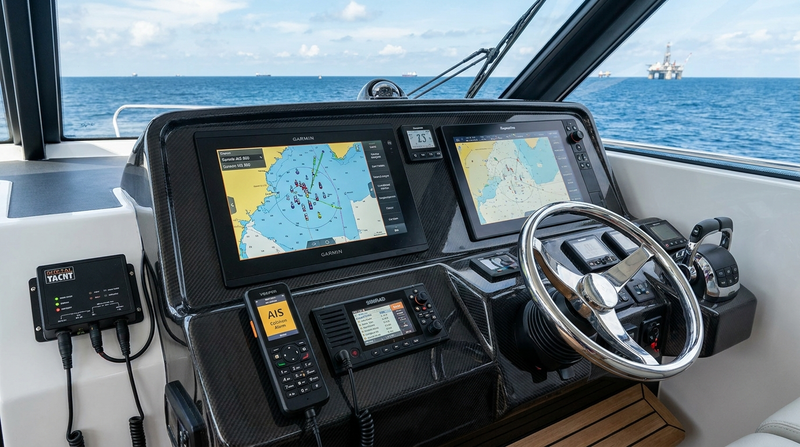
Heading sensors matter most in chop. A basic flux compass works fine in flat water. A rate gyro (like Raymarine’s EV sensor) compensates for boat motion and is dramatically better in rough conditions. NMEA 2000 integration ties the autopilot to your chartplotter so you can engage autopilot to a waypoint directly from your chart screen.

Top Marine Autopilot Systems for 2026
Raymarine Evolution EV-100 — Best Entry-Level
Price: ~$1,469-1,909 | Best for: Boats 17–35 feet
The EV-100 has been the default recommendation for mid-size recreational boats for five years. Raymarine’s EV sensor uses a nine-axis MEMS rate gyro — the same inertial measurement technology in your phone but tuned for marine conditions. The difference compared to a flux compass is obvious the first time you run through a following sea and watch the course hold instead of wander. Installation takes 3–4 hours on a wheel-steered boat and Raymarine’s documentation is genuinely good.
Garmin Reactor 40 — Best Mid-Range System
Price: ~$1,799–$4,399 | Best for: Boats 25–55 feet
The Reactor 40 is what we recommend when someone wants autopilot performance that won’t embarrass them offshore. Shadow Drive is the standout feature — take the wheel manually and the autopilot disengages instantly without touching any buttons, then reengages when you release. The 9-axis AHRS heading sensor compensates for pitch, roll, and yaw simultaneously. In 4-foot chop with beam seas, this holds course notably better than older single-axis systems. GPSMAP integration is seamless — routing a waypoint takes three button presses.
Simrad AP70 MK2 — Best for Offshore & Commercial
Price: ~$1,589–$3,489 | Best for: Boats 35 ft+, bluewater, commercial
The AP70 MK2 is not an entry-level system and it doesn’t pretend to be. This is what you buy when you’re doing overnight passages, running a sportfisher with a fly bridge, or operating a vessel that has to log hours with minimal crew fatigue. The dual-station capability is what customers mention most — run the display at the lower helm, slave a control unit at the flybridge or cockpit. Both control the same system with proper priority logic. For a sportfisher captain doing a Bahamas crossing, this isn’t a luxury — it’s a necessity.
B&G Triton2 Pilot — Best for Sailboats
Price: ~$1,679–$2,309 | Best for: Sailboats 25–45 feet
Sailboat autopilot is a different animal. Wind angle is as important as magnetic heading, and the system needs to handle deliberate heel without interpreting it as a course error. The Triton2 Pilot handles this well. Wind vane steering mode holds the boat at a set angle to the apparent wind — perfect for long downwind runs where you care about sail trim, not compass heading.
Marine Autopilot Comparison
| System | Best For | Sensor | NMEA 2000 | Price Range |
|---|---|---|---|---|
| Raymarine EV-100 | 17–35 ft | 9-axis EV sensor | Yes |
$1,469-$1,909 |
| Garmin Reactor 40 | 25–55 ft | 9-axis AHRS | Yes | $1,799-$4,399 |
| Simrad AP70 MK2 | 35 ft+ / offshore | Multi-source | Yes + RS422 | $1,589-$3,489 |
| B&G Triton2 Pilot | Sailboats 25–45 ft | 9-axis + wind | Yes | $1,679-$2,309 |
Buying Guide Questions
What kind of steering does your boat have?
Tiller, wheel-mechanical, wheel-hydraulic, or power-assisted hydraulic each require different drive units. Get it wrong and the autopilot either can’t move the helm or blows the actuator motor.
How much does your boat displace?
EV-100’s wheel drive handles up to ~6,000 lbs. EV-150 handles up to ~14,000 lbs. Between sizes, always go bigger — an underpowered drive hunts and eventually fails.
Single helm or multiple stations?
Flybridge boats, tower stations, and sportfishers often need two control points. Only the AP70 MK2 handles dual-station properly with full priority logic.
Day trips or offshore passages?
For day boating, a basic EV-100 or Reactor 40 is more autopilot than most people ever need. For overnight runs or transatlantic crossings, the AP70 MK2’s reliability and redundancy justify the price.
Bottom Line
Recreational powerboats 17–35 feet: Raymarine EV-100 or EV-150. Boats 25–55 feet doing serious offshore work: Garmin Reactor 40 — Shadow Drive is the best user experience on the market. Passagemakers and offshore sportfishers needing dual-station: Simrad AP70 MK2. Sailors: B&G Triton2 Pilot, no discussion. Whatever you choose, calibrate it properly. An autopilot that hasn’t been sea-trialed is a disappointment. One that has is one of the best investments you’ll ever make.
Give your hands a break — upgrade your autopilot
Shop All Marine Autopilots at NVN Marine →