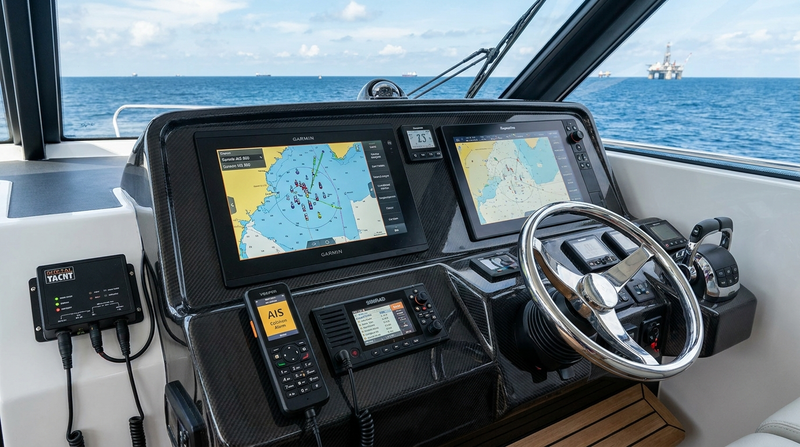
Picture this: you just dropped $1,599 on a new Garmin GPSMAP 923xsv and some more on a Simrad autopilot. You mount everything, run the power wires, and then hit the wall every first-time builder hits — how do you get these things to actually talk to each other? Why does the autopilot not know your heading? Why won't the engine instruments show up on the chartplotter?
The answer is NMEA 2000, and once you understand it, you'll realize it's one of the best-engineered standards in recreational boating. It's also one of the most consistently misunderstood. We've untangled a lot of these installs over the years — from 20-foot bay boats with three devices to offshore sportfishing builds with 15+ nodes — and the same mistakes come up every time.
This guide covers the whole thing: what NMEA 2000 actually is, how to plan and build your network, where people go wrong, and how the major brands handle compatibility. By the end you'll know exactly what to buy and how to wire it.
Already running other electronics? See our best marine chartplotters of 2026 and best marine autopilot systems guides for device recommendations that work seamlessly on NMEA 2000 networks.
What Is NMEA 2000?
NMEA 2000 is a plug-and-play networking standard developed by the National Marine Electronics Association. It's built on CAN bus technology — the same underlying protocol used in automotive systems — and lets marine electronics share data at 250 kilobits per second. That's fast enough to handle GPS position, heading, depth, wind, speed, engine data, and autopilot commands across every device on the network simultaneously.
The key thing NMEA 2000 solved: NMEA 0183, the older standard, was a one-talker-to-one-listener protocol. Your GPS could send position to one device. If you wanted two devices to receive it, you needed a splitter and separate wiring runs. It was a mess on anything bigger than a small center console.
NMEA 2000 is a true network. Every device connects to a shared backbone, every device can read every data type being broadcast, and adding a new device is usually as simple as plugging a drop cable into an available T-connector. That's the promise — and when it's set up correctly, it works exactly like that.
The Physical Network: What You're Actually Building
Before you buy anything, understand the anatomy of a NMEA 2000 network. Five components make up the whole system:
| Component | Function | Key Spec |
|---|---|---|
| Backbone cable | Main trunk running the length of the electronics area | Mid diameter (4A capacity) for most recreational builds |
| T-connectors | Inline connectors that branch devices off the backbone | Gender-specific — buy extras, you will misorder one |
| Drop cables | Connect each device to its T-connector | Maximum 6 meters per drop |
| Terminators | 120-ohm resistor caps — one on EACH end of backbone | Required on both ends — missing one causes data errors |
| Power injector | Feeds 12V to the backbone from your DC panel | One injector mid-backbone for runs under 20m; two for longer |
Planning Your Network Before You Buy
Grab a piece of paper and list every device you're connecting. Then look up its LEN value — Load Equivalency Number, which represents how much power that device draws from the NMEA 2000 network backbone. Each LEN equals 50mA. A standard power injector supports up to 50 LEN (2.5 amps).
Common LEN values for reference:
- Chartplotter / MFD: 2–4 LEN
- VHF radio (NMEA 2000 enabled): 2 LEN
- Engine gateway: 1 LEN
- Autopilot course computer: 2–3 LEN
- AIS transponder: 2 LEN
- Depth/speed/temp sensor: 1 LEN
Add them up. Most recreational boats with 6–10 devices land between 15–30 LEN total — not a problem for a single power injector. If you're pushing past 40 LEN, plan for two power injection points or a second backbone segment.
Also measure your backbone routing before buying cable. Run from where the backbone starts (usually the helm) to the last device location. Add 15–20% for routing curves and future flexibility. Splicing NMEA 2000 backbone cable inside a cramped helm station is not something you want to do twice.
Step-by-Step: Building Your NMEA 2000 Network
Don't buy components a-la-carte at first. A starter kit includes backbone cable, two terminators, a power injector, and a few T-connectors and drop cables. The Garmin NMEA 2000 Starter Kit (~$95) is a solid choice for Garmin-centric builds. Maretron offers brand-agnostic kits as well.
Run your backbone cable along the helm station. Screw in one terminator cap at each end. Do not power the network yet.
Slide T-connectors onto the backbone at every spot where a device will drop. Position them close to where the device mounts — shorter drop cables mean less signal risk and less cable clutter behind the helm.
Place the power injector near the middle of the backbone. Connect its pigtail leads to a fused 12V source — ideally a dedicated circuit rated for at least 5 amps. Never run the network power through an accessory switch; the backbone should be always-hot when the master breaker is on.
Run a drop cable from each T-connector to the corresponding device. Most modern chartplotters, autopilots, VHF radios, and engine gateways have a dedicated NMEA 2000 port. Plug in and hand-tighten the threaded waterproof connector.
Power on the network. On your chartplotter, navigate to the device list: Garmin uses Settings > My Vessel > NMEA 2000 Device List; Simrad uses System > Devices. Every connected device should appear. If anything is missing, check power, connections, and whether a brand adapter cable is needed.
Brand-Specific Notes: Where It Gets Complicated
All four major brands support NMEA 2000 but use proprietary connector systems for their own internal networks. You need adapters to connect them to a standard NMEA 2000 backbone.
Garmin Marine Network
Garmin's internal proprietary network uses a 4-pin blue connector — entirely separate from NMEA 2000. Your Garmin GPSMAP 9000 series will have both a Garmin Marine Network port and a NMEA 2000 port. Use the NMEA 2000 port for your cross-brand network backbone.
Simrad SimNet
SimNet uses the same 5-pin connector as NMEA 2000 but runs at a slightly different specification. When mixing Simrad with other brands, use a Simrad SimNet-to-NMEA 2000 adapter cable (~$38). Connecting a Simrad device directly to a standard NMEA 2000 backbone without an adapter can cause impedance mismatches and intermittent data errors.
Raymarine SeaTalkng
Same situation. SeaTalkng physically resembles NMEA 2000 but isn't interchangeable without a converter. Raymarine's A06049 SeaTalkng to NMEA 2000 Adaptor (~$55) handles the conversion — one adapter per SeaTalkng backbone segment, not per device. If you're building around a Raymarine Axiom 2 Pro, budget for this adapter.
Lowrance
Most Lowrance units from 2020 onward use standard NMEA 2000 connectors directly. Older Lowrance devices may use the "BLUE" network connector format. Check your device's manual before assuming compatibility.
Recommended Products for Your Build
| Product | Price (2026) | Use Case |
|---|---|---|
| Garmin NMEA 2000 Starter Kit | ~$95 | Best starting point; includes backbone, terminators, injector, T-connectors, drop cables |
| NMEA 2000 Extra T-Connectors (ea.) | ~$18 | Buy 2–3 extras at the start; T-connector threads are the most common failure point |
| Drop Cable 2m (ea.) | ~$28 | Covers most helm-to-device runs; 2m is the most versatile length |
| Garmin Engine Network Adapter | ~$89 | Broadcasts RPM, trim, hours, fuel flow from Yamaha/Mercury/Suzuki onto NMEA 2000 |
| Maretron N2KMeter | ~$761 | Network analyzer — shows every device, LEN draw, and flags electrical faults. Worth every penny for troubleshooting. |
| Simrad SimNet-to-NMEA 2000 Adapter | ~$38 | Required when connecting Simrad devices to a non-Simrad backbone |
| Raymarine SeaTalkng-to-NMEA 2000 Adapter | ~$55 | Required when connecting Raymarine devices to a non-Raymarine backbone |
Also worth reading before you finalize your network plan: our marine transducer buyer's guide covers transducer types and their NMEA 2000 compatibility in detail.
The Most Common NMEA 2000 Mistakes
We see these over and over on customer installs:
Missing terminator on one end. The network shows intermittent device drops, especially at startup or when the boat is cold. Check that both ends have terminators. We once spent two hours on a customer's Contender before finding that a terminator had been replaced with a spare T-connector during a previous repair.
Powering the network through a device. Some older chartplotters can power a small NMEA 2000 network through their port. Don't rely on this. Install a dedicated power injector. Device-powered networks struggle as you add more nodes — and you will add more nodes.
Too-long drop cables. Maximum is 6 meters from T-connector to device. If a device sits far from the backbone, run more backbone to bring the T-connector closer, then use a short drop.
Mixing Micro and Mid connectors without an adapter. Micro (thin 5-pin) and Mid (thicker 5-pin) connectors look similar but are physically incompatible. Don't force them. Use a Micro-to-Mid adapter cable.
Not verifying with the device list. Always finish by pulling up your chartplotter's NMEA 2000 device list and confirming every device appears. Don't assume it works because it powered on.
What NMEA 2000 Can and Can't Do
Can carry: GPS position, COG/SOG, heading, depth, water temperature, wind speed/direction, engine data, AIS targets, fuel flow, battery voltage, rudder angle, autopilot commands.
Can't carry: High-bandwidth video (forward-looking sonar video, IP cameras), high-resolution sonar imagery, large chart data files. For those needs, you run an Ethernet backbone in parallel. NMEA 2000 and Ethernet coexist on the same boat — they do different jobs.
Bottom Line
NMEA 2000 is genuinely one of the better-engineered parts of recreational boating. When it's built right — proper backbone, both terminators, dedicated power, correct adapters for your brand mix — it just works. Devices appear, data flows, and your entire helm ecosystem communicates.
Budget $150–300 for network components on a typical 6–10 device build. That's a small fraction of what you spent on the electronics themselves, and cutting corners here is where installs go wrong.
Ready to build your network?
👉 Shop All Marine Electronics Networking Gear at NVN Marine →Frequently Asked Questions
How many devices can I connect to a NMEA 2000 network?
The NMEA 2000 standard supports up to approximately 50 nodes per backbone segment. In practice, recreational boats rarely approach this limit — most builds have 5–15 devices. If you're running a large commercial or sportfish build with 20+ devices, consider splitting into two backbone segments with a network bridge.
Do I need a separate NMEA 2000 backbone from my Garmin Marine Network?
Yes. Garmin Marine Network (the proprietary 4-pin system for sharing sonar and radar between Garmin displays) and NMEA 2000 are separate networks. Your Garmin chartplotter connects to both — its NMEA 2000 port goes to the shared NMEA 2000 backbone, while its Garmin Marine Network port connects to other Garmin units for high-bandwidth data sharing.
Can I mix Simrad and Garmin devices on the same NMEA 2000 network?
Yes, and we do it all the time. Use a standard NMEA 2000 backbone as your spine. Connect Simrad devices with a SimNet-to-NMEA 2000 adapter cable. Garmin units connect directly via their NMEA 2000 port. Both will share position, heading, depth, and other standard NMEA 2000 data without issue.
Why does my NMEA 2000 network work fine at the dock but drop devices underway?
This is usually a power or termination problem. Vibration at speed can expose a loose connector or a marginal terminator. Check that both terminators are fully threaded, all T-connector connections are hand-tight, and your power injector connection isn't intermittent. A marginal 12V fuse supplying the power injector can also cause this — it holds under low load but trips briefly under vibration.
What is the maximum backbone length for a NMEA 2000 network?
The NMEA 2000 specification allows up to 100 meters of backbone. For recreational boats, you'll almost never approach this. Typical center console builds use 3–8 meters of backbone. If you're running cable from helm to engine room, plan for a second power injection point if the run exceeds 20 meters.
Is NMEA 2000 the same as SeaTalkng or SimNet?
They're based on the same underlying CAN bus technology and use physically similar 5-pin connectors, but they're not the same standard. SeaTalkng (Raymarine) and SimNet (Simrad) are proprietary implementations with differences in electrical specification. They require adapter cables to connect to a standard NMEA 2000 backbone. Don't assume a SeaTalkng cable will drop straight into a NMEA 2000 T-connector.