By the NVN Marine Expert Team — Our team has spent 10+ years on the water installing, testing, and troubleshooting marine electronics from the Gulf Coast to the Great Lakes. We’re authorized resellers for every brand we review, and we only recommend gear we’d trust on our own boats.
You spent $1,200 on a fish finder. The screen is gorgeous in the marina. You idle out, push the throttle up to 22 knots, and the display turns into a screen full of noise and false bottom echoes. That’s not a fish finder problem. That’s a transducer problem.
The transducer is the part of your sonar system that nobody talks about until something goes wrong. A mediocre transducer attached to a great unit will underperform every time. The right transducer makes a $600 fish finder look like a $2,000 one.
The Three Mount Types
Transom Mount
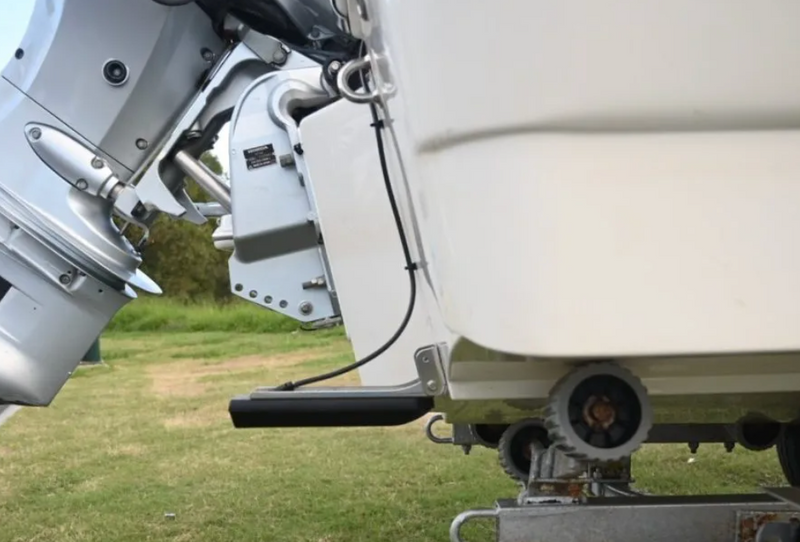
The most common type. A bracket bolts to the outside of the transom below the waterline. Install time is 2–3 hours. The trade-off is turbulence — on high-performance boats running 30+ mph, exhaust bubbles and hull spray create false signals. Below 25 mph on a V-hull, transom mounts work fine for 90% of recreational fishing applications.
Through-Hull
Installed directly through the hull — the transducer sits flush with the bottom of the boat. No protrusion, no turbulence. Maximum depth capability. Clean water contact at virtually any speed. The trade-off: you’re cutting a hole in your boat. That requires a haul-out, proper fairing to match hull deadrise angle, and careful attention to core materials. Budget $200–$500 for professional installation. Fairing blocks are required if your hull has more than ~5° of deadrise — Airmar sells them in 2° increments.
In-Hull (Shoot-Through)
Mounts inside the hull — no hole required. Epoxy the transducer to the inside of a solid fiberglass hull and the signal shoots through. Key word: solid fiberglass. This does not work with cored hulls (foam, balsa, composite core), aluminum, or wood. On a solid glass hull under ¾ inch thick, it’s a legitimate option. Thicker hulls attenuate signal more — if over 1 inch, go through-hull.

Frequency Guide
| Frequency | Best For | Max Useful Depth |
|---|---|---|
| 50 kHz | Offshore, deep water | 3,000 ft+ |
| 83 kHz | Transitional, general purpose | 500 ft |
| 200 kHz | Shallow freshwater, inshore | 500 ft |
| CHIRP Low (28–60 kHz) | Offshore depth penetration | 2,500 ft |
| CHIRP Medium (80–160 kHz) | General purpose, offshore | 1,500 ft |
| CHIRP High (150–240 kHz) | Shallow detail, freshwater | 500 ft |
Brand Breakdown & Recommended Models
Airmar — The Benchmark
Airmar manufactures transducer elements used inside Garmin, Humminbird, Lowrance, and Simrad units — then sells their own branded versions that are often the highest-performing option in a given category.
Airmar B175M Through-Hull CHIRP — ~$1,299: Medium-frequency CHIRP (80–130 kHz) through-hull that maintains solid bottom lock past 30 knots and reads to 5,000+ feet. Compatible with Garmin, Simrad, Furuno, and others. Requires fairing block matched to hull deadrise. Professional installation recommended.
Airmar P79 Transom-Mount CHIRP — ~$216: Airmar’s entry point for transom mounting. Single-element CHIRP at 130–210 kHz. Solid performance to 300 feet. If you have a Simrad or Lowrance unit and want to upgrade the included transducer, this is frequently the right move.
Humminbird
Humminbird’s MEGA Imaging technology runs at 1.2 MHz and requires Humminbird HELIX or SOLIX units. Don’t try to run a MEGA transducer on a Garmin.
Humminbird XNT 9 20 T — ~$79: Standard entry dual-beam at 200/83 kHz. Works fine for most freshwater fishing.
Humminbird XM 9 MSI T MEGA Side Imaging — ~$309: Adds MEGA Side Imaging and MEGA Down Imaging. The 1.2 MHz MEGA frequency produces resolution that’s genuinely shocking — you can read rock vs. gravel on the bottom and see individual branches of submerged timber. For tournament bass fishing, this is where to start with Humminbird.
Garmin
Garmin GT52HW-TM High Wide CHIRP — ~$276: Covers 150–240 kHz standard sonar plus ClearVû/SideVû. Garmin’s recommendation for most freshwater and inshore saltwater in water under 750 feet. Compatible with ECHOMAP UHD and GPSMAP 7400/9400 series.
Lowrance
Lowrance Active Imaging 3-in-1 — ~$373: 2D CHIRP, SideScan, and DownScan in a single body — one transducer, one cable, three imaging modes. For most freshwater and inshore anglers running Lowrance, this is the correct bundle. Stop thinking about it.
Which Transducer for Which Situation
| Situation | Best Option | Price |
|---|---|---|
| Bass boat, freshwater, budget | Humminbird XNT 9 20 T | ~$79 |
| Tournament bass, structure fishing | Humminbird XM 9 MSI T | ~$309 |
| Center console, inshore, Garmin | Garmin GT52HW-TM | ~$276 |
| Offshore center console, speed-proof | Airmar B175M through-hull | ~$1,299 |
| Lowrance HDS, all-in-one | Lowrance Active Imaging 3-in-1 | ~$373 |
| Best transom CHIRP for the money | Airmar P79 | ~$216 |
Bottom Line
Most recreational anglers in freshwater or inshore saltwater are well-served by a quality transom-mount CHIRP transducer in the $145–$240 range. Humminbird users: XM 9 MSI T. Garmin users: GT52HW-TM. Lowrance HDS owners: Active Imaging 3-in-1. If you run fast and fish offshore, budget for a through-hull and strongly consider the Airmar B175M. Don’t buy a $1,500 fish finder and pair it with a $75 single-frequency transducer. The transducer is doing the work.
Get the transducer your fish finder deserves
Shop All Marine Transducers at NVN Marine →