Picture a foggy morning off Montauk. Visibility is maybe 200 yards, you're running 18 knots toward the tide rip, and your chartplotter lights up with a target dead ahead at 1.2 nautical miles. Here's the question that actually matters: do you know what that target is, where it's going, and whether it can see you? That's the whole game with collision avoidance, and it's exactly where the AIS vs radar collision avoidance debate falls apart — because it was never really a debate. The two systems answer different questions, and the boats that stay out of trouble run both.
We get asked which one to buy "if I can only afford one" almost every week. Fair question. But before you spend a dollar, you need to understand what each device sees, what it's blind to, and why a 42-foot sportfish leaving an inlet at night wants the pair talking to each other on the same screen.
What AIS Actually Does
AIS (Automatic Identification System) is a digital transponder system. Vessels equipped with AIS broadcast their identity, position, course over ground, speed, and rate of turn over two dedicated VHF marine band channels (161.975 MHz and 162.025 MHz, if you care about the specifics). Your unit receives those broadcasts and plots the other boats as named, data-rich targets on your chartplotter.
The magic is in the data. A radar blip is anonymous — it's a smudge of returned energy. An AIS target tells you the vessel's name, MMSI number, that it's a 600-foot container ship doing 14 knots on a heading of 095°, and — this is the part that saves lives — its closest point of approach (CPA) and time to closest point of approach (TCPA), calculated automatically.
There are two flavors that matter. A Class B transponder both transmits and receives, so other boats and ships see you on their screens. An AIS receiver only listens — you see them, they don't see you. For collision avoidance, that distinction is everything. A receiver is half a safety system. We've watched too many people buy a receive-only unit to "save money" and not realize the bridge of that tanker has no idea they exist. If you want the full breakdown of transponder options, our Best AIS Transponders of 2026 buyer's guide walks through every Class B model we stock.
Modern Class B units use SOTDMA (Self-Organized Time Division Multiple Access), which transmits at 5 watts and grabs a guaranteed time slot rather than the older 2-watt CSTDMA "listen first" approach. In plain terms: SOTDMA updates faster (every 5 seconds at speed vs. every 30 for older Class B) and your target doesn't drop off a crowded harbor display. On a busy 4th of July weekend in a place like the Chesapeake, that matters more than the spec sheet suggests.
What Radar Actually Does
Radar doesn't care whether the other guy has electronics. It sends out a radio pulse and measures what bounces back. A rock, a channel marker, a rain squall, a kayaker, a steel-hull trawler with its AIS switched off — radar sees them all, because it's detecting physical objects, not listening for broadcasts.
That's the single biggest reason radar isn't optional. Roughly speaking, most of what's floating around you on a busy waterway carries no AIS at all. Recreational boats under a certain size aren't required to. Day-sailors, jet skis, fishing skiffs, that drifting log half-submerged at dusk — none of them transmit. Radar is the only thing that paints them.
Solid-state CHIRP radar (Compressed High-Intensity Radiated Pulse, the same broadband principle as modern sonar) has changed the game for smaller boats. A unit like the Raymarine Quantum 2 radar puts out around 20 watts, runs cool, mounts in a compact dome, and gives you Doppler target separation that colors approaching targets red and receding ones green right on the screen. For coastal cruisers that's plenty.
Where radar falls short: it tells you something is there, not what it is or what it intends to do. A target showing on radar at 0.8 nm could be a moored boat or a ferry on a collision course. You can work that out with MARPA (Mini Automatic Radar Plotting Aid) tracking, which calculates a target's course and CPA after a few sweeps — but it takes time, it needs a clean target, and it loses lock in sea clutter. Radar also has a minimum range. Most domes go blind inside about 20–50 feet, and in heavy rain the return clutters up badly until you tune the rain filter, which can also suppress the small targets you actually want to see.
Side by Side: Where Each One Wins
| Capability | AIS (Class B Transponder) | Marine Radar (Solid-State Dome) |
|---|---|---|
| Detects non-equipped boats | No | Yes |
| Identifies target by name/type | Yes | No |
| Auto CPA / TCPA | Yes, instant | Via MARPA, after several sweeps |
| Sees through fog & darkness | Yes (signal-based) | Yes |
| Sees rain squalls / landmasses | No | Yes |
| You become visible to others | Yes | No |
| Typical 2026 price installed | $700–$1,800 | $1,300–$2,400 |
| Power draw | ~2–3 W average | 18–40 W transmitting |
Look at that chart honestly and the conclusion writes itself. Neither column is complete. AIS can't see the boats that need seeing most — the small, fast, unlit ones. Radar can't tell you that the big contact closing at 12 o'clock is a tug towing a barge 400 yards astern on a cable you'd never spot at night. One fills the other's blind spot. For the full radar lineup, see our Best Marine Radar Systems of 2026 guide.
Why They're Better Together — On One Screen
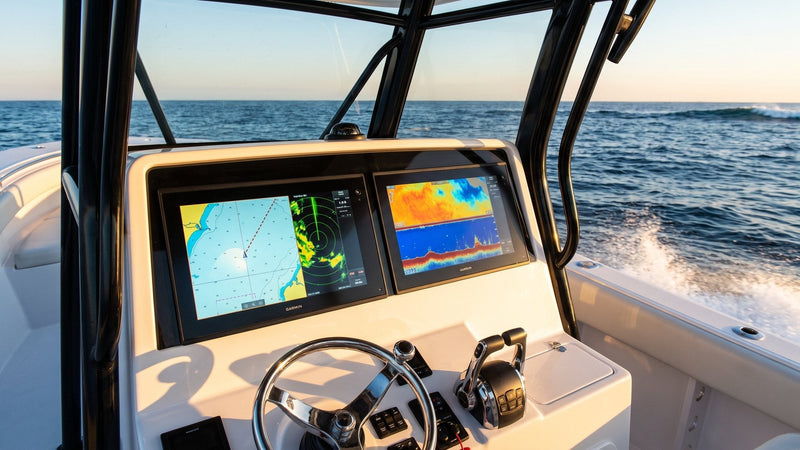
Here's where modern marine electronics earn their keep. Run both AIS and radar into the same multifunction display over an NMEA 2000 network, and the chartplotter overlays AIS targets directly onto the radar picture. Now that anonymous radar blip at 1.2 nm has a name, a heading, and a CPA tag floating next to it. The blips without AIS data? Those are the ones you watch closely, because they're the unknowns.
We've run this setup offshore in genuinely bad visibility, and the cognitive difference is night and day. Instead of staring at a radar screen trying to mentally plot whether that contact is converging, you get the commercial traffic auto-labeled by AIS and your attention freed up for the targets radar caught that AIS missed. That's not a luxury feature. That's how you avoid the situation where you're maneuvering to dodge a ship that was already going to pass two miles clear, while a center console with no lights crosses your bow.
The integration is straightforward if your gear speaks NMEA 2000. A Class B transponder like the Raymarine AIS700 or Garmin AIS 800 drops onto the backbone, your radar connects to the MFD, and the overlay is a settings toggle. One caution from experience: AIS shares the VHF antenna band, and a cheap splitter that doesn't prioritize the transponder can cost you transmit range or interrupt your VHF. Use a powered, AIS-aware antenna splitter or — better — a dedicated AIS antenna. We've chased "my AIS isn't transmitting far enough" complaints back to a $40 passive splitter more than once.
How to Choose: Questions to Ask Before You Buy
Where and when do you actually run? If you're a daytime, fair-weather, inshore bay boater who never sees commercial traffic, a good radar matters less and a basic AIS transponder buys you visibility cheaply. If you cross shipping lanes, run at night, or boat in fog country like the Pacific Northwest or New England, you want both, full stop.
Do you need to be seen, or just to see? Crossing a busy commercial inlet at night, being visible on a ship's bridge is worth more than almost anything. That argues for a Class B transponder, not a receiver, as your first purchase.
What's your boat's size and power budget? A 19-foot center console can mount a compact AIS transponder and a small dome radar without drama. Radar draws real current when transmitting, so on a small house bank, factor it in. AIS sips power and can run all day.
Is your existing gear NMEA 2000? The whole "work together" benefit depends on integration. If your MFD is a modern Garmin, Raymarine, Simrad, or Lowrance unit on an N2K backbone, both systems will overlay cleanly. Older NMEA 0183-only setups can work but get fussier.
Are you offshore or coastal? Offshore, redundancy isn't paranoia. Coastal day-running, you can phase it: AIS transponder first, radar when budget allows.
The Bottom Line
If you're forcing us to pick one to buy first, here's the honest answer, and it depends on how you boat. For most recreational boaters who run at night or in any traffic, buy the Class B SOTDMA transponder first — it's cheaper, sips power, makes you visible to the ships that can actually ruin your day, and gives you instant CPA on commercial traffic. Then add radar as the second purchase, because radar is what catches everything AIS can't see.
But understand what you're trading off in the meantime. Until you have radar, you are blind to every boat without a transponder — and that's most of them. So if you boat in fog, around floating debris, or anywhere with heavy small-craft traffic, don't phase it. Run both, network them, and put the AIS overlay on your radar screen. That combined picture is the closest thing to a second set of eyes you can bolt to a boat.
We stock and install both, and we'll tell you straight which combination fits your boat and your water — not whatever has the fattest margin.
👉 Shop All AIS Systems at NVN Marine →
Frequently Asked Questions
Do I need both AIS and radar, or is one enough?
For full collision avoidance, you want both. AIS identifies vessels that transmit (mostly commercial ships and other equipped boats) and makes you visible to them, while radar detects everything physically around you — including the many small craft that carry no AIS at all. One sees what the other is blind to. If budget forces a choice, a Class B transponder is usually the smarter first buy for boaters who run at night or near commercial traffic.
Will an AIS transponder make my boat visible to big ships?
Yes, but only a transponder, not a receiver. A Class B transponder broadcasts your position, course, and speed on the VHF AIS channels, so your boat appears as a named target on other vessels' chartplotters and the bridge displays of commercial ships. A receive-only AIS unit lets you see them but leaves you invisible — which is why we steer collision-avoidance buyers toward transponders.
Can radar see boats that don't have AIS?
Yes — that's radar's biggest advantage. Radar detects physical objects by bouncing radio energy off them, so it sees unlit skiffs, sailboats, kayaks, channel markers, and even some floating debris regardless of whether they carry any electronics. AIS only shows vessels that actively broadcast, so radar is essential for spotting the non-equipped traffic that makes up most recreational boats.
What's the difference between Class A and Class B AIS?
Class A is required equipment on large commercial vessels and transmits at higher power (12.5 W) with priority time slots. Class B is the recreational standard — modern Class B SOTDMA units transmit at 5 W with guaranteed slots and faster updates than older 2-watt Class B models. For pleasure boats, a Class B SOTDMA transponder gives you nearly all the practical benefit at a fraction of the cost.
How do AIS and radar work together on one display?
When both feed a multifunction display over an NMEA 2000 network, the MFD overlays AIS target data on top of the radar image. Radar contacts that also carry AIS get labeled with the vessel's name, heading, and closest point of approach, while contacts with no AIS data stand out as unknowns to watch. It turns two separate pictures into one prioritized situational-awareness screen.
Do I need a separate antenna for AIS?
Ideally, yes. AIS performs best with a dedicated VHF antenna, but you can share your existing VHF antenna through a powered, AIS-aware splitter. Avoid cheap passive splitters — they can cut transmit range or interrupt your VHF radio. A dedicated antenna or a quality active splitter is cheap insurance for a system whose whole job is keeping you visible.