A hole in the ice is an 8-inch window into a lake you can't see. Without sonar, you're guessing. With the wrong sonar, you're still guessing, just with a screen.
Picking the best ice fishing fish finder isn't really about brand. It's about three technologies that behave very differently once the air hits single digits: the old-school flasher, the LCD graph, and live sonar. We've set up all three for customers, and we've taken the January calls when a screen went sluggish at 12 below.
Here's the ice guide we wish people read in September: real prices, cone angle math, and the cold-weather failures nobody puts in the box.
Flasher vs LCD vs live sonar: pick the category first
Flashers are a spinning ring of light around a dial. The depth reads around the circle, and every return shows up the instant it happens. No screen refresh, no scrolling history, no lag. Flashers also shrug off cold in a way LCDs don't.
LCD units give you a scrolling graph, GPS, maps, and a waypoint of the spot you marked in July. Most have a flasher mode on screen, but it's a simulation. It's good. It isn't a real flasher, and below about 0°F you'll see the difference.
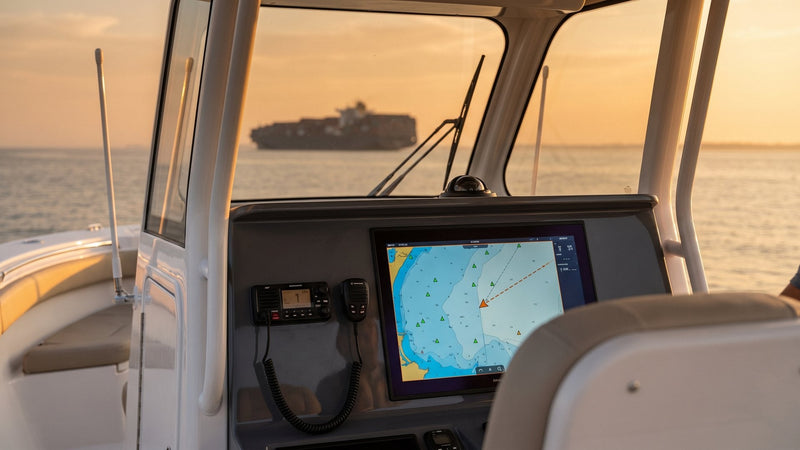
Live sonar (Garmin LiveScope, Humminbird MEGA Live, Lowrance ActiveTarget) shows you a real-time picture of fish around the hole. You can watch a crappie swim over from 40 feet away. It's also three to seven times the price of a good flasher and it'll run a battery down faster than you expect.
Our honest take: a flasher is still the best first ice unit for most anglers. Live sonar is the best second unit.
The cone angle math nobody does
On the ice you can't move to cover water, so beam angle matters more than it does on a boat. Coverage diameter at the bottom is roughly 2 × depth × tan(half the cone angle).
| Depth | 9° cone | 12° cone | 19° cone |
|---|---|---|---|
| 10 ft | 1.6 ft | 2.1 ft | 3.3 ft |
| 20 ft | 3.1 ft | 4.2 ft | 6.7 ft |
| 30 ft | 4.7 ft | 6.3 ft | 10.0 ft |
At 20 feet, a 12° ducer is looking at a circle about 4.2 feet across. A 19° ducer covers about 6.7 feet, which is roughly 2.5 times the bottom area. That wider cone shows you more fish. It also tells you less about where they are, because a fish on the edge of a 19° cone and a fish directly under your bait look almost the same on a dial.
We run 12° for jigging walleye and perch tight to the bottom in 20 to 35 feet, where precision matters. We run 19° for suspended crappie in shallower basins, where finding the school is the whole game. If you fish both, a dual-beam transducer or a flasher pack with a swappable ducer earns its keep. Our CHIRP sonar explainer explains the frequency and beam width trade-off.
Best ice flashers for 2026–27
Vexilar FLX-28 Pro Pack II — our default recommendation
The Vexilar FLX-28 Pro Pack II with Pro-View Ice-Ducer at $619.99 is the flasher we'd buy if we could only own one. It's been a guide favorite in shack villages for years, and the reason is the interference rejection. When eight shacks are within 50 yards of each other, a flasher without good IR turns into a fireworks show. The FLX-28's is adjustable and it works.
The Pro Pack II is fishing-ready out of the box. The Pro-View Ice-Ducer sold separately is $125.99 if you ever need a spare, which you will if you ever drop one down a hole without the float set.
Vexilar FLX-18 Pro Pack II — the value pick
The Vexilar FLX-18 Pro Pack II at $470.99 gives up some of the FLX-28's display modes and saves you about $150. For a weekend angler fishing mostly alone, it's plenty. If you want to go cheaper still, the FL-8SE Genz Pack with a 19° Ice-Ducer is $355.99 and the FLX-12 Genz Pack with a 12° ducer is $404.99.
Vexilar FLX-38 BB Pro Pack Elite — for deep water and fish stacked tight
The FLX-38 BB Pro Pack Elite with Broad Band Ice-Ducer is $699.99, and it's the one we point lake trout anglers toward. Broadband separates targets better, which matters when a laker is sitting 8 inches off the bottom in 60 feet and a standard flasher paints it as part of the bottom.
Humminbird ICE-55 — the alternative
The Humminbird ICE-55 ice fishing flasher at $507.99 is a solid flasher with a zoom function that's easy to read. Most buyers already run Humminbird on the boat. We don't think it beats the FLX-28 on interference handling, but it's not a bad choice.
Best LCD ice fish finders
Garmin Striker Plus 4 Ice Bundle — cheapest way in with GPS
At $379.99, the Garmin Striker Plus 4 Ice Fishing Bundle is hard to argue with. You get CHIRP sonar, an on-screen flasher mode, GPS waypoints, and Garmin's Quickdraw Contours for making your own maps. The 4.3-inch screen is small, but for someone new to hard water it's our pick.
For $30 more, the Striker Vivid 5cv ice bundle at $409.99 gets you a 5-inch screen, and that alone is worth it.
Humminbird ICE HELIX 5 CHIRP GPS G3 — the all-season workhorse
The ICE HELIX 5 CHIRP GPS G3 is $559.99. It's a boat unit that comes with an ice setup. Mark spots in summer, carry the same waypoints onto the ice in December. If you don't need GPS, the sonar-only ICE HELIX 5 CHIRP G3 is $392.99.
Garmin ECHOMAP UHD2 5cv Ice — for serious mapping
The ECHOMAP UHD2 5cv ice bundle at $599.99 brings real chartplotting to the bucket. For big water and offshore reefs, it's the LCD to own.
Best live sonar for ice fishing
Live sonar changed ice fishing more than anything since the flasher. Buy the right package.
- Garmin LiveScope Plus Ice Fishing Kit (you supply a compatible Garmin display) $1,969.99
- Garmin ECHOMAP UHD2 93sv LiveScope Plus Ice Bundle (complete with 9-inch display) $2,909.99
- Humminbird Ice Xplore 9 MEGA Live 2 Bundle $2,849.99
- Humminbird Ice Xplore 10 MEGA Live 2 Bundle $3,499.99
- Lowrance ActiveTarget 2 with transducer and module, plus the Lowrance Explorer ice bag with transducer pole at $376.99 $1,399.00
- Garmin Panoptix PS22 Ice Fishing Bundle with UHD display $1,309.99
If you already run LiveScope Plus on your boat with a 7-inch or larger ECHOMAP or GPSMAP, the $1,969.99 ice kit is the smart buy. If you're starting from zero, the ECHOMAP UHD2 93sv bundle at $2,909.99 is the complete package. A 9-inch screen is the smallest we'd want for live sonar.
Lowrance owners get the cheapest entry into true live sonar. ActiveTarget 2 plus the Explorer bag comes to about $1,776, but it needs an HDS or Elite FS display to run. LiveScope is sharper at range, ActiveTarget is easier on the wallet.
The Panoptix PS22 is the honest budget option. It isn't LiveScope-sharp, but it shows real-time returns around the hole with a display included.
How they compare
| Vexilar FLX-28 Pro Pack II | Garmin Striker Plus 4 Ice | Humminbird ICE HELIX 5 GPS | Garmin LiveScope Plus Ice Kit | Humminbird Ice Xplore 9 MEGA Live 2 | |
|---|---|---|---|---|---|
| Type | Flasher | LCD | LCD | Live sonar (display not included) | Live sonar + display |
| Real-time response | Instant | Near-instant (flasher mode) | Near-instant (flasher mode) | Live video | Live video |
| GPS / waypoints | No | Yes | Yes | Via Garmin display | Yes |
| Cold-weather screen lag | None | Noticeable below 0°F | Noticeable below 0°F | Noticeable below 0°F | Noticeable below 0°F |
| Use on the boat too | No | Limited | Yes | Yes, with your boat display | Ice-focused bundle |
| Price at NVN | $619.99 | $379.99 | $559.99 | $1,969.99 | $2,849.99 |

Cold-weather failures we see every winter
Lithium won't charge below freezing
LiFePO4 (lithium iron phosphate) batteries power almost every ice unit now. They discharge fine in the cold. They should not be charged below 32°F, and most packs have a battery management system that simply refuses. Customers call us convinced the charger is dead when the pack just spent the night in an unheated garage. Warm it inside for an hour, then charge. A spare Vexilar 12V 12Ah lithium battery is $69.89 and it's cheap insurance for a two-day trip.
LCD screens slow down at sub-zero
Liquid crystal gets sluggish in the cold. Below about 0°F you'll see ghosting and a laggy graph, and at 20 below some screens look like they're running through syrup. It's not damage, and it recovers when the screen warms. A flasher doesn't care.
Condensation between the truck and the shanty
Bring a frozen unit into a 60-degree shack and the inside of the screen can fog. Moisture that gets past a gasket and then refreezes is how units die. Let it warm gradually in its case. Don't set it on the heater.
The transducer freezes into the hole
Leave a ducer in an unattended hole on a cold day and the skim ice grabs the cable. Never pry it out. Pour a little warm water or dip the cable back into open water to free it. Set the float so the ducer face sits just below the bottom of the ice, and clear the skim every time you check it.
Interference in a group
Flashers from the same family often run the same frequency. Two of them 10 feet apart will paint each other's pings. Use the interference rejection, space holes as far apart as your group can stand, and have one angler switch frequency if the unit allows it.
Convert your boat unit instead of buying new
If you already own a Humminbird HELIX or a Lowrance HOOK² on the boat, you may not need a second unit at all. The Humminbird HELIX ICE conversion kit is $322.99 and moves your HELIX into a portable shuttle. Lowrance owners can add the Lowrance ice transducer for HOOK² 5, 7, 9 and 12 for $74.59. The Lowrance Elite FS 7 All-Season Pack at $1,049 is built from day one to go boat-to-ice.
The real payoff is the waypoints. Every weed edge, rock pile, and basin transition you marked in July is already in the unit when the lake locks up. If your transducer choices on the boat are still in flux, our marine transducer buyer's guide walks through compatibility.
Questions to ask before you buy
Do you fish alone or in a crowd? Crowds make interference rejection the most important spec on the box. That's the FLX-28.
How deep do you fish? Under 30 feet, any of these works. Past 50 feet for lake trout or burbot, go broadband (FLX-38 BB) or live sonar.
Do you already have GPS waypoints you care about? Then an LCD or a conversion kit makes more sense than a standalone flasher.
Is live sonar in the budget this year? If not, buy a flasher now and add live sonar next season. Plenty of anglers run both side by side.
When are you buying? Now. Ice packs and live sonar kits tend to sell through by late November, and December restocks are unpredictable.
The bottom line
Buy the Vexilar FLX-28 Pro Pack II at $619.99 if this is your first serious ice unit. It works at 25 below, it handles a crowd, and it'll outlast three generations of screens.
If you're ready for live sonar and you don't already own a Garmin display, the ECHOMAP UHD2 93sv LiveScope Plus Ice Bundle at $2,909.99 is the complete setup we'd take onto the ice ourselves. If you're already running LiveScope on the boat, grab the ice kit and read our LiveScope Plus setup guide before your first trip out.
Order before November. Want help matching a transducer to your depth or converting your boat unit? Call us at (212) 688-0550. We'll tell you what you actually need.
---
Authorized Vexilar, Humminbird, Garmin & Lowrance dealer · Same-day shipping before 3 PM EST · Full manufacturer warranty
Shop All Fish Finders at NVN Marine →Frequently asked questions
Is a flasher or an LCD fish finder better for ice fishing?
A flasher is better for pure jigging response and cold-weather reliability, because it has no screen lag and keeps working well below 0°F. An LCD is better if you want GPS waypoints, maps, and a scrolling history.
What cone angle should I use for ice fishing?
Use a 12° cone for precise jigging close to the bottom, and a 19° cone for finding suspended fish in shallower water. At 20 feet, a 12° cone covers about 4.2 feet across the bottom while a 19° cone covers about 6.7 feet, roughly 2.5 times the area.
Why won't my lithium ice fishing battery charge?
Most LiFePO4 batteries will not charge below 32°F. Their battery management system blocks charging to protect the cells. Bring the battery into a warm room for an hour before plugging it in. It will still discharge normally on the ice.
Can I use my boat fish finder for ice fishing?
Yes, if you add an ice transducer and a portable power source. Humminbird offers HELIX ice conversion kits starting at $322.99, and Lowrance sells ice transducers for HOOK² units for $74.59. You also keep all the waypoints you marked on open water.
Is live sonar worth it for ice fishing?
For anglers who fish often and chase roaming fish like crappie, yes. Live sonar shows fish moving around the hole in real time so you can decide which ones to target. Budget $1,300 to $3,500 depending on whether you need a display. For occasional anglers, a quality flasher is still the better value.
How do I stop fish finder interference when fishing near other anglers?
Turn up your unit's interference rejection, space holes as far apart as practical, and switch to a different frequency if your unit offers one. Flashers from the same brand often run on the same frequency, which is the most common source of crosstalk on the ice.