By the NVN Marine Expert Team — Our team has spent 10+ years on the water installing, testing, and troubleshooting marine electronics from the Gulf Coast to the Great Lakes. We're authorized resellers for every brand we review, and we only recommend gear we'd trust on our own boats.
Pull up to any tournament ramp in 2026 and count the trolling motor shafts with a black puck zip-tied to them. Half of them are Garmin LiveScope Plus. The other half are Lowrance ActiveTarget 2. The two systems have basically swallowed the live forward-facing sonar market, and the argument about which one is better never actually ends — it just moves from the dock to the boat ramp to the comment section.
We've rigged both. Not in a showroom, not off a spec sheet. We've zip-tied LVS34 transducers to Ultrex shafts, run ActiveTarget 2 pole mounts on aluminum jon boats, and stared at both screens for more hours than we'd like to admit, watching crappie suspend over brush at 28 feet. So this isn't a feature-table regurgitation. This is what the two systems actually do when there's a fish on the line and you're trying to put a jig two inches from its nose.
Here's the short version before we get into it: both are excellent, both will help you catch more fish, and the "winner" depends almost entirely on what graph is already on your bow. The deeper you go, the more interesting the differences get.
What live sonar actually is (30-second version)
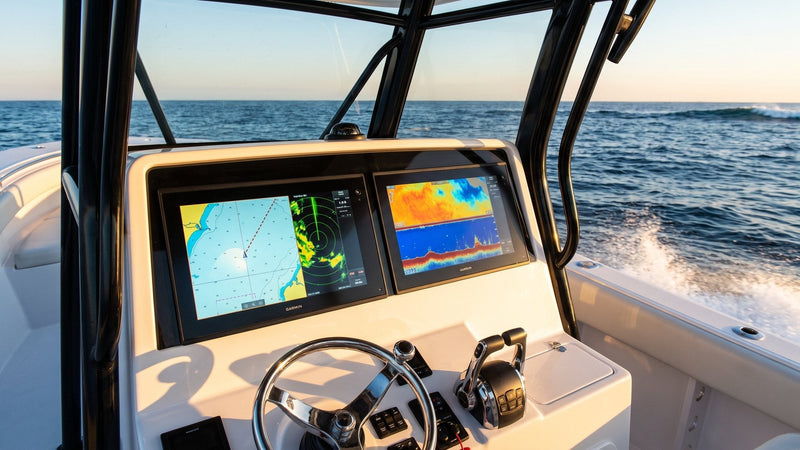
Forward-facing live sonar shows you fish and structure in real time, in front of the boat, moving as they move. It's not the scrolling history of traditional 2D sonar or even CHIRP — it's a live feed. You can watch a bass turn toward your bait, refuse it, and slide back into a brush pile. If you're new to the category, our breakdown on CHIRP sonar explained covers how this differs from the sonar you grew up with.
Both ActiveTarget 2 and LiveScope Plus do this. The differences are in resolution, range, how the image holds together at distance, and — honestly — which brand's chartplotter you're already locked into.
Garmin LiveScope Plus: the system that started the gold rush
Garmin lit the fuse on this whole category, and the Garmin LiveScope Plus system is the refined version of the unit that did it. It's a two-piece setup: the GLS 10 sonar black box and the LVS34 transducer. Three modes — Forward, Down, and Perspective — and you switch between them by physically adjusting the transducer angle or, more commonly, leaving it in Forward and living there.
The full system with the GLS 10 box runs about $599 in 2026. If you already own a GLS 10 from an older LiveScope setup, the LVS34 transducer alone is around $1,059, which is the upgrade path most existing Garmin owners take.
What it does well: the Perspective Mode is genuinely useful for seeing a wide swath of bottom in shallow water, almost like a side-scan you can aim. Target separation is excellent inside 50 feet. And the ecosystem is massive — if you run a Garmin ECHOMAP UHD2 or a GPSMAP, LiveScope plugs in and just works. We walk through the full rigging process in our Garmin LiveScope Plus setup guide.
Where it frustrates us: the GLS 10 box is one more thing to mount, wire, and find a dry home for. On a small boat that's a real packaging headache. And past about 70–75 feet of forward range, the image starts getting soft. It's still readable, but you're interpreting blobs more than reading fish.
Lowrance ActiveTarget 2: the resolution play
Lowrance came at this differently. The ActiveTarget 2 leans hard on image clarity and a cleaner integration story. The module-plus-transducer-plus-mounts package lists around $1,399 in 2026 — and notice there's no separate black box hanging off your console. The module is small and the system is built to talk to an HDS Pro or HDS Live unit over the network.
The big sell is resolution. Side by side at 25–40 feet, ActiveTarget 2 renders fish with a crispness that makes individual baitfish in a ball easier to pick apart. Scrolling history along the bottom of the screen is also more detailed, which matters more than people admit — being able to glance at where a fish was helps you predict where it's going.
Lowrance also released the ActiveTarget 2 XL, an extended-range transducer with a 25-foot cable aimed at deep-water and offshore crappie and walleye crews who fish 40-plus feet regularly. If you spend your days over deep brush or standing timber in 50 feet of water, the ActiveTarget 2 XL is the version to look at — it holds the image together deeper than the standard puck.
Where it frustrates us: the ActiveTarget 2 ecosystem is smaller. You're committing to Lowrance HDS as your display, and if you're a Garmin household, that's a tough pill. We've also seen the transducer pick up more cavitation noise at higher trolling-motor speeds if the mount isn't dialed in — solvable, but it takes patience on the install.
Head to head: what the screens actually show
We ran both on the same brush pile, same day, 30 feet of water, fish stacked at 22–26 feet.
Inside 40 feet, ActiveTarget 2 had the edge on raw clarity. Baitfish balls were easier to separate, and the jig showed up as a tighter, more defined mark. If your fishing is mostly shallow-to-mid and you live in the 15–45 foot zone — which describes most crappie and bass fishing in the country — that resolution advantage is real and you'll notice it.
Push out past 60 feet and the gap narrows, then flips depending on transducer. Standard LiveScope Plus and standard ActiveTarget 2 both get soft out there. But the ActiveTarget 2 XL specifically pulls ahead at distance — that's its whole reason to exist.
Perspective Mode is the one thing Garmin does that Lowrance has no direct answer for. For scanning flats and locating fish before you ever point the boat at them, it's a legitimately different tool. Tournament guys who use it to graph an entire flat from one position swear by it.
Comparison table
| Feature | Garmin LiveScope Plus (LVS34) | Lowrance ActiveTarget 2 |
|---|---|---|
| 2026 price (full system) | ~$1,499 (with GLS 10 box) | ~$1,399 (module + xdcr + mounts) |
| Transducer-only price | ~$1,199 (LVS34) | ~$1,099 (ActiveTarget 2 xdcr) |
| Black box required | Yes (GLS 10) | No (compact module) |
| Modes | Forward, Down, Perspective | Forward, Down, Scout |
| Resolution inside 40 ft | Excellent | Best-in-class |
| Effective forward range | ~70–75 ft (XR for deep) | ~60–70 ft (XL for deep) |
| Display ecosystem | Garmin ECHOMAP / GPSMAP | Lowrance HDS Pro / HDS Live |
| Standout feature | Perspective Mode | Image clarity + scrolling history |
| Deep-water version | Panoptix LiveScope XR | ActiveTarget 2 XL |
How to actually decide (the questions that matter)
What chartplotter is already on your boat? This is the real first question, and it answers 80% of the decision. If you run Garmin, buy LiveScope. If you run Lowrance HDS, buy ActiveTarget 2. Cross-shopping a transducer onto the wrong brand's display isn't a thing — these are closed ecosystems.
How deep do you fish? Mostly under 45 feet? Either standard system is plenty, and ActiveTarget 2 gives you a slight clarity edge. Living in 45–70 feet over deep brush or timber? Look hard at the XL (Lowrance) or XR (Garmin) range transducers.
Do you have room for a black box? Tight on a small boat or a kayak? ActiveTarget 2's lack of a separate box is a genuine packaging win. On a big center console it's a non-issue.
Do you want Perspective Mode? If scanning flats from a stationary position is how you locate fish, Garmin is the only one offering it natively.
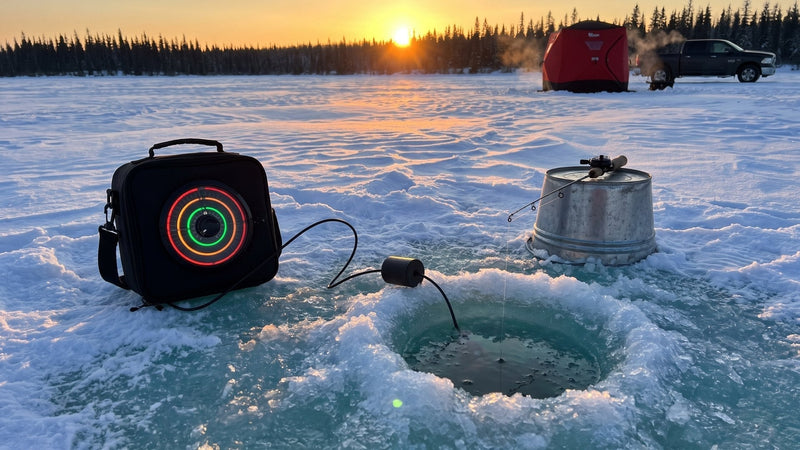
What's your transducer mount situation? Both ride on the trolling motor for forward viewing. If you want to run it on a dedicated pole or a livewell-mount for ice and dock shooting, factor a mount into the budget.
The bottom line
If you're building a boat from scratch with no brand loyalty, here's how we'd call it. For shallow-to-mid-depth fishing where image clarity wins tournaments — crappie, bass, inshore — the Lowrance ActiveTarget 2 is the one we'd hang on the trolling motor, and the XL if we fished deep. For anyone already in the Garmin world, or anyone who wants Perspective Mode to scan water fast, LiveScope Plus is the obvious, proven call.
Neither will disappoint you. The bad live sonar units left the market years ago. What's left is two genuinely great systems fighting over the last 10% of performance, and that last 10% comes down to depth, display brand, and whether you'd rather scan a flat or read a brush pile.
👉 Shop All Live Sonar at NVN Marine →
Frequently Asked Questions
Is Lowrance ActiveTarget 2 better than Garmin LiveScope Plus?
Inside about 40 feet, ActiveTarget 2 has a slight edge in raw image resolution and detail in its scrolling history. LiveScope Plus counters with Perspective Mode and a much larger display ecosystem. The "better" unit is almost always the one that matches the chartplotter already on your boat.
Can I run Garmin LiveScope on a Lowrance chartplotter?
No. LiveScope only works with compatible Garmin ECHOMAP and GPSMAP displays, and ActiveTarget 2 only works with Lowrance HDS Pro and HDS Live units. These are closed ecosystems — you commit to a display brand when you choose your live sonar.
Do I need the black box for live sonar?
Garmin LiveScope Plus requires the GLS 10 sonar black box. Lowrance ActiveTarget 2 uses a compact module with no separate box to mount, which is a real advantage on small boats and kayaks where space is tight.
What's the difference between ActiveTarget 2 and ActiveTarget 2 XL?
The XL is an extended-range transducer with a longer 25-foot cable, built to hold image quality at greater depths and distances. If you regularly fish past 45 feet over deep brush, timber, or offshore structure, the XL is worth the upgrade. For shallow-to-mid fishing, the standard transducer is plenty.
How deep does forward-facing live sonar work?
Both standard systems give a usable forward image to roughly 60–75 feet before detail softens. Deep-water transducers — the ActiveTarget 2 XL and Garmin's Panoptix LiveScope XR — extend that meaningfully for crews fishing deep timber and offshore structure.
Is live sonar worth it for casual anglers?
If you fish a few weekends a year for fun, a quality CHIRP fish finder will serve you well and cost far less. Live sonar earns its price for anglers who fish often, target suspended or pressured fish, and want to watch how fish react to their bait in real time. It's a force multiplier, not a beginner's first graph.