Half the offshore helms we rip out weren't wrong because the sonar was weak. They were wrong because somebody bought a fish finder and expected it to run a 60-mile canyon trip.
Picking the best chartplotter for offshore fishing is a different job from picking a sounder. On a 25- to 45-foot center console or sportfish, the screen at the helm has to get you to a temperature break 50 miles out, show you the squall line building behind you, overlay radar on the chart when the fog sits down at 4 AM, run the autopilot, and then mark bait on a 1kW transducer. The fish-finding part matters. It's just one of five jobs.
We've rigged all six brands below on boats from a 25-foot walkaround to a 43-foot express sportfish. Here's what we'd put on our own helms in 2026, with current NVN Marine pricing.
What offshore actually asks of a chartplotter
Four things separate an offshore helm from a bay-boat helm.
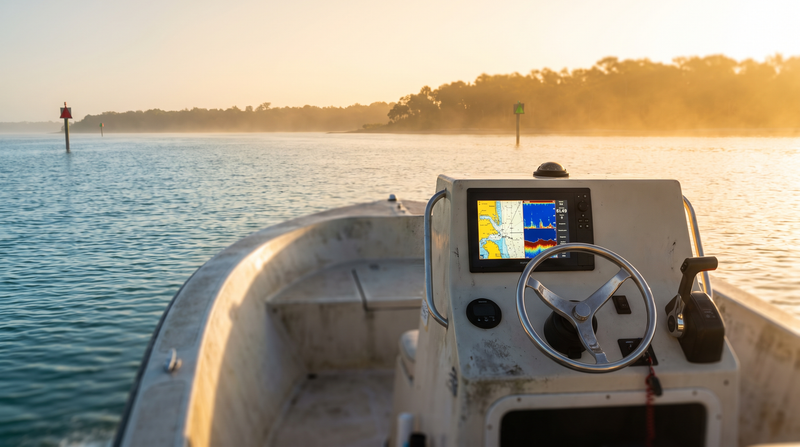
Screen size. On a boat that pounds at 30 knots in a 3-foot chop, a 12-inch split screen is unreadable. For 25 to 33 feet we want one 16-inch display at minimum. For 34 to 45 feet, two 16s or a single 19- to 24-inch glass helm, because you'll be running chart, radar, and sonar at the same time and none of them should be thumbnail-sized.
Sonar power. Offshore bottom is 200 to 1,500 feet down. A 600-watt all-in-one transducer loses bottom around 400 feet at speed. You want a 1kW CHIRP (Compressed High-Intensity Radiated Pulse) transducer at minimum, and 2kW or 3kW if you drop deep or chase swordfish.
Radar integration. Not "can it display radar." Can it overlay radar on the chart, track MARPA targets, and stay stable with heading data? That's an ecosystem question, and it locks you in.
Satellite weather and SST. A SiriusXM Marine receiver brings live radar, lightning, wind, wave height and, on the offshore tiers, sea surface temperature (SST) contours right onto your chart. Finding the 2-degree break without SST is guesswork.
Garmin GPSMAP 8616xsv — best value for 25–33 foot center consoles
If a customer with a 28-foot center console calls and asks for one screen that does everything, this is what we ship. The Garmin GPSMAP 8616xsv is $4,719.99 with Garmin Navionics+ charts and built-in 1kW CHIRP traditional sonar plus ClearVü and SideVü. The non-sonar GPSMAP 8616 is $4,299.99 if you're adding a second screen to an existing Garmin network.
What sells it offshore is the ecosystem. The GXM 54 SiriusXM weather antenna ($675.99) plugs straight in, the GMR Fantom 24x dome ($2,999.99) overlays cleanly, and a Reactor autopilot answers to the same screen.
The weak spot: that 1kW built-in port is wasted on a $400 transom all-in-one. Pair it with a real 1kW transducer or you've paid for power you're not using. And the 8600 platform is a few years old now. Layer radar overlay, 3D chart and split sonar at once and you'll feel it redraw.
Garmin GPSMAP 9000 series — best glass helm for 34–45 foot sportfish
The 9000 series is where Garmin put its fastest processor and, on the 19- to 24-inch models, 4K resolution. We covered it in depth in our GPSMAP 9000 series breakdown for offshore boaters, so here's the short version with current pricing:
- GPSMAP 9217 17-inch $6,699.99
- GPSMAP 9217xsv 17-inch with built-in sonar $7,199.99
- GPSMAP 9219 19-inch $10,199.99
- GPSMAP 9222 22-inch $11,699.99
- GPSMAP 9224 24-inch $13,699.99
The big screens don't have sonar inside. Budget for a GSD 28 sonar module at $2,999.99 and, for serious deep-drop work, the Airmar 509LHW 3kW through-hull at $4,669.99. That's close to $19,400 for a 22-inch helm with 3kW sonar before radar.
Honestly, for a 30-foot center console that's too much money in one place. Two 8616xsv units cost about $9,440 and give you redundancy: if one screen dies 40 miles out, you still have a chart. On a 40-foot express with a flybridge, though, a 9222 at the lower helm is the right call.
Simrad NSS16 evo3S and NSO — best for autopilot-heavy boats
Simrad's argument has always been the pilot. On boats where the autopilot does most of the steering on the run out, Simrad's integration between the screen and its own course computers is the smoothest we install.
- Simrad NSS16 evo3S $5,499.00
- Simrad NSO evo3S 16-inch system pack $6,999.00
- Simrad NSO evo3S 24-inch system pack $9,999.00
- Simrad NSO 4-16 glass bridge display $6,599.00
Buy the NSO as a system pack. The display-only listings exist for adding screens to an existing NSO network, and we've had customers order one expecting a standalone plotter. It isn't one.
For offshore sonar, add the Simrad S5100 module ($2,298.00). It runs three independent CHIRP channels, so you can watch a 1kW low-frequency channel on the bottom and a high-frequency channel on the bait at once. SiriusXM goes through the Navico WM-4 receiver at $529.00, and HALO radar is the native pairing.
Our gripe: the evo3S interface has more menu depth than it needs, and new owners take a few trips to find the SST overlay settings. If you're starting a new build, look hard at the newer NSO 4 generation rather than the evo3S.
Raymarine Axiom 2 XL 16 — best navigation interface
Of everything here, LightHouse 4 on an Axiom 2 is the operating system we hand to a first-time offshore owner with the least worry. It's fast, the menus are shallow, and the chart redraw keeps up with a boat doing 40 knots.
- Axiom 2 XL 16 glass-helm display $5,999.99
- Axiom 2 XL 16 with RVM1600 sonar module $6,699.99
- Axiom 2 Pro 16 RVM with built-in sonar $6,544.99
The XL is a glass-helm display with no sonar inside, so buy the RVM1600 bundle or choose the Axiom 2 Pro 16 RVM, which has sonar built in. We broke down the generational differences in Axiom Pro vs Axiom 2 Pro.
Radar is the Quantum 2 Doppler dome with 15M cables at $2,684.99, and SiriusXM runs through the SR200 receiver at $413.99, the cheapest weather receiver on this list.
Where Raymarine trails: deep-water bottom sonar. RealVision 3D is great for structure inside 200 feet. For 1,000-foot bottom tracking at speed, Furuno and Garmin's high-power setups are better.
Lowrance HDS PRO 16 — best for fishing-first boats on a budget
The HDS PRO 16 without a transducer is $4,799.00, or $4,899.00 with an Active Imaging HD transducer. For the money it's the most sonar-focused 16-inch screen you can buy.
It's honest to say this is a fish finder that navigates well, not a navigation system that fishes. Charting on C-MAP Discover is solid. Radar, autopilot and WM-4 weather all work through the Navico ecosystem. But on a boat that crosses 70 miles of open water, we'd rather have the Simrad version of the same ecosystem. Add the S3100H sonar module ($987.00) for high-power CHIRP offshore.
On a 23- to 27-foot center console that fishes 20 miles out, this is the smart buy. Our HDS 16 LIVE review covers how the navigation side holds up.
Furuno TZtouch3 — best offshore sonar, best dollar-per-watt
Charter captains in the canyons run Furuno for a reason. The bottom discrimination and fish sizing on Furuno's built-in 1kW dual-channel CHIRP are, in our experience, the best of any MFD on this list.
- Furuno TZtouch3 16-inch with 1kW CHIRP $3,779.99
- Furuno TZtouch3 19-inch with 1kW CHIRP $5,309.99
- Furuno TZT16X TZtouchXL 16-inch $6,195.00
That $3,779.99 price on the 16-inch TZT3 is remarkable for a screen with 1kW sonar inside. It looks like runout pricing as the TZtouchXL takes over, so don't sit on it. You'll spend real money on the transducer — the TM275LHW transom-mount CHIRP is $1,669.99 — but the pairing is excellent.
The DRS4DL+ radar dome at $1,879.99 is the cheapest radar in this roundup, and the BBWX4 SiriusXM receiver is $449.99. The trade-off is the interface: TimeZero is powerful but less intuitive than Garmin or Raymarine, and your crew will need a day with it.
Side-by-side comparison
| Display | Screen | Sonar inside | Native radar | SiriusXM receiver | NVN price |
|---|---|---|---|---|---|
| Garmin GPSMAP 8616xsv | 16" | 1kW CHIRP + ClearVü/SideVü | GMR Fantom | GXM 54 ($675.99) | $4,719.99 |
| Garmin GPSMAP 9222 | 22", 4K | None (GSD 28 module) | GMR Fantom | GXM 54 ($675.99) | $11,699.99 |
| Simrad NSS16 evo3S | 16" | CHIRP + StructureScan | HALO | WM-4 ($529.00) | $5,499.00 |
| Raymarine Axiom 2 XL 16 | 15.6" | None (RVM1600 bundle) | Quantum 2 | SR200 ($413.99) | $5,999.99 |
| Lowrance HDS PRO 16 | 16" | Active Imaging HD + CHIRP | HALO | WM-4 ($529.00) | $4,699.00 |
| Furuno TZtouch3 16 | 16" | 1kW dual-channel CHIRP | DRS series | BBWX4 ($449.99) | $3,779.99 |
Radar, satellite weather and SST: plan them with the screen

SST is the offshore feature people underuse. On a SiriusXM Marine offshore-tier subscription, sea surface temperature contours overlay directly on the chart. Set the color palette so a 2°F change is obvious, then plan your route across the break instead of trolling blind to the last numbers someone posted. It's the single biggest fishing upgrade on this list, and it's not sonar.
Heading data is the other piece. Radar overlay and MARPA need a heading source on the network, and our NMEA 2000 network setup guide covers the backbone rules that trip people up.
Four questions before you order
How far do you actually run? Under 25 miles, a single 16-inch combo with 1kW sonar covers it. Past 40 miles, you want two screens, radar and satellite weather. That's not optional.
What's already on the boat? Radar, pilot and transducers lock you in. Replacing a working Fantom radar to switch brands adds $3,000 to the real price.
Where will the transducer go? A 1kW or 2kW through-hull on a deep-V hull needs a fairing block and a haul-out. Plan it with the screen, not after.
Can the dash fit it? A 16-inch unit needs roughly 17 by 11 inches of flat dash, and the exact cutout varies by model. Measure first, and read our guide to installing a chartplotter on a center console before you cut.
The bottom line
For a 25- to 33-foot center console, buy the Garmin GPSMAP 8616xsv at $4,719.99, a GXM 54, and a Fantom 24x. That's roughly $8,400 before you add a real 1kW transducer, for a helm that navigates, forecasts, sees through fog and finds bottom at 800 feet.
If you're the captain who cares more about reading the bottom than anything else, the Furuno TZtouch3 16 at $3,779.99 is the better fishing machine and the price won't last.
On a 38- to 45-foot sportfish, run a pair of large glass-helm screens from one ecosystem, Garmin 9000 or Simrad NSO, and don't economize on the radar.
Not sure what fits your dash or your existing network? Call us at (212) 688-0550. We'll ask about your boat before we talk about screens. Want the whole category, including coastal picks? Start with our best marine chartplotters of 2026 guide.
Authorized Garmin, Simrad, Raymarine, Lowrance & Furuno dealer · Same-day shipping before 3 PM EST · Full manufacturer warranty
Shop All Chartplotter/Fish Finder Combos at NVN Marine →Frequently asked questions
What size chartplotter do I need for an offshore fishing boat?
For 25 to 33 feet, one 16-inch display is the practical minimum because you'll split chart, radar and sonar at once. For 34 to 45 feet, run two 16-inch screens or a single 19- to 24-inch glass helm. Two screens also give you a backup chart if one fails far from shore.
Is 1kW sonar enough for offshore fishing?
For most offshore fishing in 100 to 800 feet of water, a 1kW CHIRP transducer is enough. For deep-dropping, swordfishing or reliable bottom past 1,000 feet, step up to a 2kW or 3kW transducer on a matching black-box sonar module. The transducer matters as much as the display's wattage rating.
Can I mix brands, like a Garmin chartplotter with Simrad radar?
Not for radar, sonar modules or satellite weather receivers. Each brand's radar and weather receiver only work with that brand's displays. Basic NMEA 2000 data like engine, GPS, depth and heading can be shared across brands, but plan your screen, radar and weather receiver as one system.
Do I need SiriusXM satellite weather offshore?
If you run more than 20 miles out, we'd call it essential. Cell coverage ends early, and SiriusXM Marine delivers live radar, lightning, wind and wave data on the chart. The offshore subscription tiers also add sea surface temperature overlays, which are one of the best tools for finding fish.
Which chartplotter brand is best for offshore fishing in 2026?
For an all-around navigation and fishing helm on a 25- to 33-foot center console, we recommend the Garmin GPSMAP 8616xsv. For the best bottom sonar per dollar, the Furuno TZtouch3. For autopilot-heavy boats, Simrad. For the easiest interface, the Raymarine Axiom 2.
Should I buy one large screen or two smaller ones?
On a center console under 35 feet, two 16-inch screens usually beat one 22-inch screen: they cost less and give you redundancy. On a larger sportfish with a bigger dash, a 19- to 24-inch glass helm makes sense, ideally with a second screen networked as a backup.