By the NVN Marine Expert Team — Our team has spent 10+ years on the water installing, testing, and troubleshooting marine electronics from the Gulf Coast to the Great Lakes. We're authorized resellers for every brand we review, and we only recommend gear we'd trust on our own boats.
A customer called us in March asking whether he should grab a Humminbird Solix 10 he'd found at a steep discount, or spend more on the new XPLORE 10 that replaced it. That's the real Humminbird Solix 10 review question in 2026, and it deserves a straight answer — not a rehash of a 2023 spec sheet.
Here it is up front: the Solix 10 is still one of the best live-sonar platforms Humminbird ever built, and at today's clearance and used prices it's a legitimate bargain for the right angler. But Humminbird discontinued the Solix line in 2025 when the XPLORE series launched, and that changes the math on software updates, resale value, and long-term support. We'll walk through what the Solix 10 does brilliantly, where it genuinely annoys us, and who should buy one versus who should put that money toward an XPLORE 10 CMSI+.
The Short Version
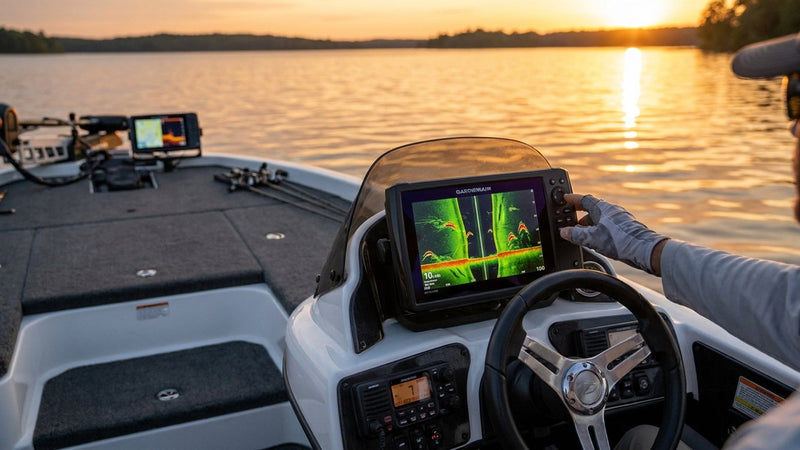
The Solix 10 CHIRP MEGA SI+ G3 was Humminbird's mid-flagship: a 10.1-inch, 1280×800 display with both touchscreen and full keypad control, Dual Spectrum CHIRP sonar, MEGA Side Imaging+ and MEGA Down Imaging+, dual ethernet ports, NMEA 2000, Bluetooth, and full One-Boat Network integration with Minn Kota trolling motors. It ran about $2,199 new in 2025. In mid-2026, remaining new-in-box units and clean used ones trade between $1,600 and $1,900.
For serious anglers, the headline is networking. This unit was built to run MEGA Live forward-facing sonar (today that means MEGA Live 2, $1,399.99) and the MEGA 360 pod at the same time, on the same screen, without choking. Plenty of 10-inch units claim that. The Solix actually delivers it, and that's why tournament guys kept two of them on the console for years.
What the Solix 10 Gets Right
The screen and the controls. The 10.1-inch display is bright enough to read through polarized sunglasses at noon, which sounds basic until you've fished behind a unit that isn't. More important is Cross Touch — Humminbird's combination of touchscreen plus a real keypad and jog dial. Touchscreens are great at the dock. In 2-foot chop at 40 mph, they're miserable. The keypad means you can change ranges, drop waypoints, and switch views with wet, cold hands while the boat is moving. We've run this unit in 6-foot Lake Erie slop, and the keypad is the difference between adjusting your sonar and giving up on it.
MEGA Side Imaging+. Honest range on side imaging is about 100 feet per side before detail falls apart, even though the spec sheet says more. Within that window, the imaging is crisp enough to tell a brush pile from a rock pile and to spot individual crappie holding in standing timber. Down Imaging+ reads cleanly past 150 feet, which covers essentially all inland fishing. (Curious how the frequencies behind this work? Our CHIRP sonar explainer covers it.)
Processing headroom. This is the quiet advantage over the cheaper Helix line. Run side imaging, 2D sonar, mapping, and MEGA Live simultaneously on a Helix 10 and you'll see the redraw stutter. The Solix shrugs it off. Split the screen four ways and it keeps scrolling at full speed.
AutoChart Live. The Solix records your own 1-foot contour maps as you idle, which matters more than people think on reservoirs where the Navionics data was flown decades ago. We've found offshore ledges on Kentucky Lake that appear on no commercial chart, purely from idling around with AutoChart Live recording.
Live Sonar: Where the Solix Earns Its Keep
MEGA Live on a Solix 10 is the setup that changed how a lot of our customers fish. Watching a bass track your jig in real time at 30 feet is genuinely addictive, and the Solix's processor draws the MEGA Live picture with less lag than the Helix units — noticeably less, maybe a quarter second, which matters when you're trying to keep a bait in a fish's face.
Two practical notes from installs we've done. First, MEGA Live pulls about 1.5 amps on its own, and a full Solix-plus-MEGA-Live-plus-MEGA-360 rig will drain a single cranking battery embarrassingly fast. Budget for a dedicated 12V house battery, minimum 100Ah lithium if you fish all day. Second, mount the MEGA Live transducer on the trolling motor shaft, not a separate pole, unless you're prepared to add a $400 mount and drill more holes. The Minn Kota integration through One-Boat Network makes the trolling-motor mount the clean option.
The 2025-launched MEGA Live 2 transducer also runs on Solix hardware after the final firmware updates — Humminbird did right by owners there. You get the improved target separation, though a few of the newest display filters remain XPLORE-only.
Where It Falls Short
No sugarcoating this section.
Boot time. Cold start to fishable screen is 45 seconds to a minute. Garmin units are on-plane in half that. If you make short runs between spots all day, you'll leave it running, which circles back to the battery budget.
Weight and depth. The Solix 10 is a chunky unit — over 7 pounds with the gimbal bracket — and it sits deep. In-dash mounting on a smaller console gets tight; measure before you commit, and use the proper IDMK S10 in-dash mounting kit rather than improvising a flange.
The interface has a learning curve. The menu system is deep and occasionally illogical — sonar settings live in three different places. Give yourself two full trips before judging it. Coming from a Helix, the first day is frustrating.
It's discontinued. The big one. Humminbird ended Solix production in 2025. Firmware maintenance has continued longer than we expected, but new features are landing on XPLORE and APEX only. Parts and service remain available (Humminbird historically supports discontinued lines for years — ONIX owners got parts well past end-of-life), but you're buying a platform at the end of its road.
Buying a Used Solix 10: Our Inspection Checklist
Most Solix 10s changing hands right now come off tournament boats, which means hard miles, lots of trailer vibration, and sometimes a winter in an unheated barn. None of that is disqualifying. Here's what we check before we'd hand anyone money.
- Power it up in front of you on a 12V battery. Watch the entire boot. A unit that hangs on the splash screen or reboots on its own isn't a bargain at any price.
- Drag a waypoint across the whole screen. Dead touch zones show up at the edges first. Look for fogging in the corners and uneven backlight while you're at it.
- Press every key and spin the jog dial. Rubber keys harden under UV. A sticky button is a negotiating point, not a dealbreaker.
- Shine a flashlight into the power and transducer ports. Green on the pins means salt or moisture got in, and that tends to get worse, not better.
- Run the transducer cable through your hands. Nicks and crush marks where it passed through the transom let water wick inside the jacket. Plug it in and ping 2D in a bucket at minimum.
- Check the software version in the system info screen. If it isn't the final Solix release, plan to update from a card before you expect MEGA Live 2 to work.
- Get the serial number on the receipt. Electronics walk off tournament boats. A seller who won't write the serial down is telling you something.
What a Complete Solix 10 Live-Sonar Rig Actually Costs
The head unit is the cheap part. Here's what we'd put on a bass boat running a Minn Kota Ultrex, at current NVN Marine prices:
| Component | What it does | Price |
|---|---|---|
| Solix 10 CHIRP MEGA SI+ G3 (used/clearance, transducer included) | Head unit, 2D, MEGA SI+/DI+ | $1,600–1,900 |
| Humminbird MEGA Live 2 | Forward-facing live sonar | $1,399.99 |
| MEGA 360 Imaging for Ultrex / Ultrex QUEST | 360-degree imaging around the bow | $1,080.99 |
| Go Power 100Ah Group 31 LiFePO4 | Dedicated electronics battery | $772.99 |
| Humminbird AS EC 10E ethernet cable | Networks a second display at the bow | $44.19 |
| IDMK S10 in-dash kit | Flush mount at the console | $53.99 |
The core rig (Solix, MEGA Live 2, and the battery) lands between $3,770 and $4,070. Add MEGA 360 and you're near $5,000. Skip 360 unless you fish a lot of offshore structure or brush piles; MEGA Live and side imaging cover most of what 360 shows you, and that $1,081 buys a lot of tackle.
Solix 10 vs XPLORE 10: The 2026 Decision
| Solix 10 CHIRP MEGA SI+ G3 | XPLORE 10 CMSI+ | |
|---|---|---|
| Street price (2026) | $1,600–1,900 (clearance/used) | $2,049.99 new |
| Display | 10.1" 1280×800, Cross Touch | 10.1" 1280×800, Cross Touch, brighter panel |
| Sonar | Dual Spectrum CHIRP, MEGA SI+/DI+ | Dual Spectrum CHIRP, MEGA SI+/DI+ |
| Live sonar | MEGA Live / MEGA Live 2 (full support) | MEGA Live 2 (all features, lowest latency) |
| Networking | Dual ethernet, NMEA 2000, Bluetooth | Ethernet, NMEA 2000, Bluetooth, updated OBN |
| Software future | Maintenance only | Active development |
| Mapping | AutoChart Live, CoastMaster/LakeMaster | AutoChart Live, updated LakeMaster VX |
The XPLORE runs a faster processor and a cleaner interface, and it's the platform Humminbird is building on for the next five-plus years. XPLORE pricing has come down, so the gap is now only $150 to $450. For a tournament angler who upgrades every three seasons anyway, a clean Solix at the bottom of that range with the transducer included is still money in your pocket. Anywhere near $1,900, it isn't. And for someone planning to keep one unit for eight years, buy the XPLORE 10 and stop thinking about it. Smaller consoles can step down to the XPLORE 9 CMSI+; if you've got the dash real estate, the XPLORE 12 CMSI+ is the same brain with more glass.
Before You Buy: Four Questions
What transducer comes with it? Used Solix units often show up without the transducer, and a replacement MEGA SI+ transducer runs $350+. Confirm what's in the box. If you want cleaner high-speed readings on a deep-V hull, the XP-14-HW in-hull CHIRP transducer is the upgrade we install most often. (New to transducer choices? Start with our through-hull vs transom mount guide.)
Do you already own Minn Kota? One-Boat Network integration (heading-linked 360, Spot-Lock from the sonar screen) is half the value of this platform. If you run a Garmin or Lowrance trolling motor, a lot of the magic disappears — read our ActiveTarget 2 vs LiveScope Plus face-off before committing to a brand ecosystem.
Is your power system ready? Solix 10 alone draws about 2 amps; with MEGA Live and 360 you're near 5. All-day fishing needs a dedicated house battery.
Cables and spares. Grab a spare PC12 power cord while they're still cheap and plentiful. Discontinued-platform accessories only get more expensive.
Bottom Line
The Solix 10 remains a serious live-sonar machine, and 2026 clearance pricing makes it the best value in big-screen Humminbird gear — for anglers who understand they're buying the end of a product line. Buy it used or on clearance at $1,600–1,800 with the transducer included, pair it with MEGA Live 2 on a Minn Kota, and you have the same core live-sonar rig as an XPLORE 10 build for a few hundred dollars less. Buy the XPLORE 10 instead if you're starting fresh, keeping it long-term, or want every MEGA Live 2 feature Humminbird ships from here on.
Not sure which fits your boat? Call us at (212) 688-0550 — we've installed both and we'll tell you honestly, or start with our chartplotter and fishfinder combo buyer's guide. Comparing within the Humminbird family? See our rundown of MEGA Imaging on the Helix 9, 10 and 12.
👉 Shop All Fish Finders at NVN Marine →
Frequently Asked Questions
Is the Humminbird Solix 10 discontinued?
Yes. Humminbird ended Solix production in 2025 when the XPLORE series launched. Remaining new units are sold as clearance stock, and Humminbird continues to provide firmware maintenance and parts support, but new features now ship on XPLORE and APEX only.
Does the Solix 10 work with MEGA Live 2?
Yes. The final Solix firmware updates added MEGA Live 2 transducer support, including improved target separation. A few display filters introduced in 2026 are exclusive to XPLORE and APEX units, but core MEGA Live 2 performance is fully there on Solix.
Is the Solix 10 worth buying in 2026?
At $1,600–1,900 with a transducer included, yes — for anglers who want flagship-level networking and live sonar performance and don't mind buying a discontinued platform. If you plan to keep one unit for many years, the XPLORE 10 CMSI+ is the smarter long-term buy.
What's the difference between the Solix 10 and the Helix 10?
Processing power and controls. The Solix runs multiple sonar feeds (side imaging, 2D, MEGA Live) simultaneously without lag, adds Cross Touch (touchscreen plus keypad), dual ethernet ports, and a higher-resolution panel. The Helix 10 is lighter and cheaper but stutters under heavy multi-sonar loads.
How much power does a Solix 10 draw?
Roughly 2 amps on its own at 12V. Add MEGA Live (about 1.5A) and a MEGA 360 pod and a full rig approaches 5 amps — figure 50–60Ah consumed over a full day. We recommend a dedicated 100Ah lithium house battery for all-day live-sonar fishing.
Can the Solix 10 control a Minn Kota trolling motor?
Yes. Through the One-Boat Network, a Solix 10 can engage Spot-Lock, follow contours, and control an Ultrex or Terrova directly from the sonar screen, and heading data from the motor orients MEGA 360 imaging.