By the NVN Marine Expert Team — Our team has spent 10+ years on the water installing, testing, and troubleshooting marine electronics from the Gulf Coast to the Great Lakes. We’re authorized resellers for every brand we review, and we only recommend gear we’d trust on our own boats.
Walk into any serious boater’s wheelhouse and the chartplotter is the first thing you notice. It’s the brain of the navigation setup — the screen everyone stares at when a squall rolls in or the inlet gets shallow in a hurry. Getting it wrong is an expensive mistake. Getting it right means years of confidence out on the water.
We’ve mounted, wired, and sea-trialed a lot of these units. Some have impressed us, some have frustrated us, and a few have genuinely changed how we navigate. This guide covers every major brand’s best 2026 offerings, what actually separates them, and which one makes sense for your boat and your budget.
Why Chartplotter Choice Matters More Now
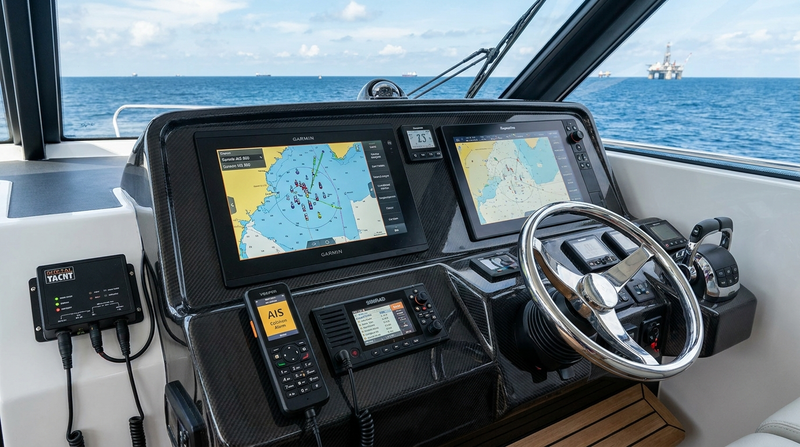
Modern chartplotters aren’t just GPS displays. They’re networked hubs that tie together radar, sonar, AIS, autopilot, engine data, and weather. A unit that can’t handle that network cleanly — or that locks you into one proprietary ecosystem — will cost you real money down the road in workarounds and adapter cables.
The other thing that’s changed: screen quality. The gap between a $600 unit and a $2,500 unit used to be mostly processing speed and GPS accuracy. Today the difference is in how well the screen performs in direct Florida sun, whether the touchscreen works with wet hands, and how fast the radar overlay refreshes.
Best Marine Chartplotters of 2026 by Brand

Raymarine: Best for Radar and Autopilot Integration
Raymarine’s current lineup is anchored by the Axiom 2 Pro series, and it’s the unit we’d install on most center consoles in the 25–35 foot range. LightHouse Charts with Navionics+ data is included out of the box — you’re not paying extra for the charts that actually matter. The anti-reflective coating does real work in direct afternoon sun.
Best for: Boaters who want tight Raymarine ecosystem integration (autopilot, radar, thermal)
Starting price: ~$749 (Axiom 2 7”) | ~$1,249 (Axiom 2 Pro 9”)
Simrad: Best for Offshore Performance
The Simrad NSS evo3S has been the standard for serious offshore navigators for a while now. StructureScan 3D sonar integration, HALO radar compatibility, and GoFree wireless connectivity all still lead the class for a dedicated navigation/fish combo unit. Run an NSS evo3S with a full NMEA 2000 network — radar, autopilot, engine data, AIS, dual sonar — and it keeps up under load.
Best for: Offshore fishing captains, bluewater cruisers
Starting price: ~$1,599 (NSS evo3S 9”)
Garmin: Best for Freshwater Anglers
Garmin plays differently — their strength is vertical integration. The GPSMAP 9000 series with Livescope Plus integration is the default recommendation for tournament bass anglers. BlueChart g3 cartography is excellent for coastal U.S. waters and the split-screen between chartplotter and Garmin sonar has no noticeable lag.
Best for: Freshwater tournament anglers, full Garmin ecosystem
Starting price: ~$1,999 (GPSMAP 9000 16”)
Lowrance: Best Value in 2026
The Lowrance HDS-16 Live remains one of the best chartplotter/sonar combos at its price point. Live sonar integration — ActiveTarget and StructureScan 3D — is class-leading for the money. Do the NMEA 2000 wiring right (quality connectors, proper termination) and the system is rock-solid.
Best for: Anglers prioritizing sonar, boaters on a $1,000–$1,500 budget
Starting price: ~$999 (HDS-9 Live)
B&G: Best Chartplotter for Sailors
Sailors have different priorities — laylines, wind data, polar charts, tide overlays, gybing angles. The B&G Zeus3S is designed around sailing navigation in a way that other brands’ sailing modes can’t fully match. SailSteer shows wind angle, layline projections, and VMG data in one clean display. For powerboaters, B&G doesn’t add much that Simrad or Garmin doesn’t do better.
Best for: Monohull sailors, offshore racers, performance cruising
Starting price: ~$1,299 (Zeus3S 9”)
Quick Comparison: Top Chartplotters of 2026
| Model | Best For | Screen Sizes | Starting Price |
|---|---|---|---|
| Raymarine Axiom 2 Pro | Radar + autopilot | 7”, 9”, 12”, 16” | ~$749 |
| Simrad NSS evo3S | Offshore performance | 7”, 9”, 12”, 16” | ~$1,599 |
| Garmin GPSMAP 9000 | Freshwater + Livescope | 16”, 19”, 22”, 24” | ~$1,999 |
| Lowrance HDS-16 Live | Best value combo | 7”, 9”, 12”, 16” | ~$999 |
| B&G Zeus3S | Sailing navigation | 7”, 9”, 12”, 16” | ~$1,299 |
How to Choose: Key Questions
What’s already on your boat?
Matching your new chartplotter to existing electronics (radar, transducer, autopilot) matters more than brand loyalty. A clean NMEA 2000 network integration saves days of setup headaches.
Power or sail?
Sailors should look at B&G first, then Simrad. Powerboaters have more flexibility — Raymarine, Simrad, Garmin, and Lowrance are all excellent depending on use case.
What’s your sonar situation?
If you’re primarily a fisherman, consider combo units — HDS Live, GPSMAP 9000, NSS evo3S. If navigation is the priority and sonar is secondary, a standalone chartplotter may be cleaner.
Screen size vs. helm space
Bigger isn’t always better. A 16-inch display on a 22-foot boat creates mounting problems and visibility blocks. Measure your helm space before you spec anything.
Our Bottom Line
For most coastal boaters on a powerboat 22–36 feet, the Raymarine Axiom 2 Pro hits the right balance of performance, ease of use, and value. The Simrad NSS evo3S is what we’d choose for offshore bluewater work or serious radar + autopilot networks. Garmin wins for freshwater tournament fishing with Livescope. For sailors, B&G isn’t a discussion — it’s the answer.
Ready to upgrade your navigation?
Shop All Marine Chartplotters at NVN Marine →
Frequently Asked Questions
Ready to upgrade your navigation setup? Browse our full selection of marine chartplotters or reach out for a free compatibility consult.