By the NVN Marine Expert Team — Our team has spent 10+ years on the water installing, testing, and troubleshooting marine electronics from the Gulf Coast to the Great Lakes. We're authorized resellers for every brand we review, and we only recommend gear we'd trust on our own boats.
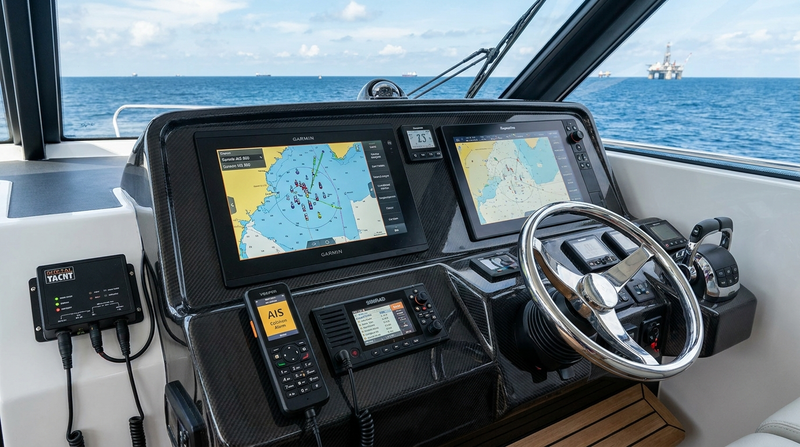
Offshore boating demands gear that won't quit when you're 40 miles from the inlet with a building sea and a thunderhead on the horizon. The Garmin GPSMAP 9000 series was built for exactly that environment. We've been running these units on center consoles and express cruisers since they shipped — tournament boats, liveaboard cruisers, charter sportfishers — and after two seasons of real-world installs, we have a lot to say about what Garmin got right, what they overengineered, and where the 9000 series actually sits in the current MFD market.
Here's the full breakdown.
In This Review
What's Actually in the GPSMAP 9000 Series
Garmin doesn't make it easy to compare models at first glance. The 9000 series spans five SKUs, each targeting a different helm layout and budget bracket.

GPSMAP 9019 — $10,999
The 19-inch flagship and the most-installed unit in our shop this past season. At 1920×1080 resolution with brightness topping 1,200 nits, you can read it in full Florida sun without cupping your hands around the screen. We've put four of these on tournament center consoles this year. Zero failures, zero warranty claims, zero complaints from captains running them hard. Best value in the lineup for boats in the 25–32 foot range.
GPSMAP 9022 — $11,631
At 22 inches, this hits the sweet spot for boats in the 30–40 foot range with a hardtop. Screen real estate matters at this size. Running a split view — chart on the left, radar and sonar on the right — everything stays legible. The touch interface is responsive even with wet hands, which is not universal in this class. Older Lowrance units with similar specs would ghost-touch in spray. The 9022 doesn't.
GPSMAP 9024 — $13,630
Twenty-four inches and nearly $6,300. This is built for vessels where the helm station sits 3–4 feet from the captain's eyes, or for bridge setups on 50-plus-foot sportfishers. For most recreational boaters: skip it. Buy the 9022 and put the $1,500 difference toward a Garmin GMR Fantom radar dome — better overall system.
GPSMAP 9212 and 9222
The 9212 is a standalone 12-inch touch display; the 9222 pairs a 22-inch main screen with a 12-inch secondary. These work well for express cruisers with narrow helms or as secondary bridge stations. We haven't logged as many hours with the combo units, but the installs have been clean and captains have been satisfied.
What Garmin Gets Right
BlueChart g3 Charts: Genuinely Best in Class
Garmin's built-in BlueChart g3 offshore charts have gotten sharper, more accurate, and more intuitive every generation. Coverage for the Gulf Coast, Bahamas, Florida Keys, and Northeast corridor is comprehensive. Depth shading is accurate enough to actually navigate by — we verified it against known bottom contours running out of the Keys on our test boat.
Auto Guidance routing is worth calling out. Garmin's AI-assisted routing calculates a safe path through channels, shoals, and bridges based on your vessel's draft, height, and beam. We've used this extensively in the Intracoastal Waterway where bottom contours are inconsistent, and the routes checked out against our own manual chart reading every time. It's a tool we've come to trust rather than distrust — which is not something we say lightly.
For a full breakdown of how BlueChart g3 compares in the broader chartplotter market, see our Best Marine Chartplotters of 2026 buyer's guide.
Panoptix LiveScope Integration
For anglers, this is where the GPSMAP 9000 series separates itself. Pair one with a Garmin Livescope Plus system and you get real-time live scanning sonar — fish and structure rendered in real time at up to 200 feet forward and 135 feet down, depending on conditions and vessel speed.
On the GPSMAP 9000 screen, the Panoptix display is the cleanest we've seen on any MFD platform. Fish arches are distinct and separated from noise. The split-screen view showing traditional CHIRP sonar alongside the live scanning view is easy to interpret at a glance, even underway. Simrad's ActiveTarget 2 integration is good, but Garmin's Panoptix pipeline feels more native — a system designed together rather than an accessory bolted on.
NMEA 2000 Network Depth and Stability
The 9000 series handles NMEA 2000 backbone loads better than most units at this price point. We've run networks with 12 or more nodes — radar, sonar, autopilot, VHF radio, wind instruments, depth sensors, AIS transponder, engine data — and haven't experienced the bus slowdowns that affected some older Garmin units from the 8000 series era. NMEA 0183 is still supported, which matters for legacy instruments you're not ready to replace.
OneHelm Wi-Fi networking allows up to four units to share sonar, radar, and chart data — two screens at the helm station and one at the bridge can all display the same fish target without duplicating transducers. We set this up on a 42-foot sportfisher and it worked exactly as advertised.
Where the GPSMAP 9000 Falls Short
Firmware Updates Come Slowly
Garmin pushes firmware updates for the 9000 series roughly every four to six months. Simrad and Raymarine both release more frequent incremental updates. The 9000 software is stable enough that you won't be waiting on a critical fix — but if you need a specific bug patched, you may be waiting a quarter. Simrad users are more likely to see that fix within a month.
The Sonar Is Offshore-Optimized, Not Freshwater-First
The GPSMAP 9000 runs CHIRP sonar, DownVü, SideVü, and Panoptix — but it's tuned for offshore depth profiles. Reading bottom structure in 150–400 feet is excellent. For freshwater fishing under 30 feet, the transducer options are more limited than a dedicated Humminbird or Lowrance fish finder. If bass fishing is your primary use case, add a dedicated unit. If you fish offshore for bottom fish and structure, the built-in capability is solid.
Price vs. Simrad NSS evo3S
The GPSMAP 9022 at $11,631 competes directly with the Simrad NSS evo3S 16-inch, which runs about $3,949. Garmin's BlueChart g3 outperforms C-MAP in our opinion, and Panoptix integration is a real differentiator. But if you're already a Simrad household — autopilot, VHF, radar all Simrad — the switching cost in adapters, cable changes, and learning a new interface isn't always justified. Switching ecosystems mid-build costs real money and real time.
GPSMAP 9000 vs. The Competition
| Feature | Garmin GPSMAP 9022 | Simrad NSO evo3S 16 | Raymarine Axiom Pro 16 |
|---|---|---|---|
| 2026 Price (est.) | $11,631 | $6,199 | $3,949 |
| Screen Size | 22 inches | 16 inches | 16 inches |
| Built-in Charts | BlueChart g3 | C-MAP | LightHouse |
| Live Sonar | Panoptix (add-on) | ActiveTarget 2 (add-on) | RealVision 3D |
| Autopilot Integration | GHP Reactor | Simrad NAC-3 | Evolution |
| NMEA 2000 | Full | Full | Full |
| Firmware Updates | Quarterly | Monthly | Bi-monthly |
| Warranty | 2 years | 2 years | 2 years |
The Raymarine Axiom Pro 16 runs LightHouse Charts — free and regularly updated via Wi-Fi — and offers RealVision 3D sonar in higher-spec configurations. For sailors and coastal cruisers who want a capable chartplotter without committing to a sonar ecosystem, it's compelling at $3,949. We covered it in full in our Axiom Pro vs. Axiom 2 Pro comparison.
5 Questions to Ask Before You Buy
What size is your boat and how far is the helm from your eyes?
Under 30 feet: the 9019 is more than enough, and the 9022 may actually be too large for a clean in-dash mount. 30–45 feet: the 9022 is the sweet spot. Larger vessels with a proper bridge or a long helm run: look at the 9024 or the 9212/9222 combo.
Do you run Panoptix live sonar, or plan to?
If Panoptix is in your future, the GPSMAP 9000 is the best MFD platform for it. No other chartplotter integrates LiveScope as natively. If you're not an angler and sonar is secondary, the NSS evo3S and Axiom Pro become more competitive on price.
What's your chart area?
BlueChart g3 is exceptional for U.S. coastal waters, Caribbean, Great Lakes, and Gulf of Mexico. If you regularly run international routes beyond those zones, verify BlueChart g3 coverage before you commit to the platform.
Are you in an existing Garmin ecosystem?
Already running a Reactor autopilot, GMR Fantom radar, and GHC instruments? Staying Garmin is straightforward. Crossing to Simrad or Raymarine means adapter cables, software configuration, and learning a new UI — all of which have a real cost.
What's your sonar plan?
The GPSMAP 9000 is chartplotter-first, sonar-capable. Excellent at offshore bottom reading. Outstanding with Panoptix. For the best inshore or freshwater sonar, pair it with a dedicated fish finder — don't ask the 9000 to do everything at maximum performance.
 Bottom Line
The Garmin GPSMAP 9000 series is the right chartplotter for offshore-focused boaters who want best-in-class navigation charts, rock-solid NMEA 2000 networking, and the cleanest Panoptix live sonar integration available in an MFD. The 9022 is where we'd put most buyers in the 30–45 foot range. The 9019 is the best value in the lineup for smaller center consoles. And the 9024 is for large-boat captains with bridge helm setups — essentially everyone else should pass.
If you're on a tighter budget or primarily run inshore and coastal, look hard at the Simrad NSS evo3S or Raymarine Axiom 2 Pro. Either will cover most needs for $800–$1,500 less. But for the offshore captain building a serious helm with a full electronics suite? The GPSMAP 9000 series is what goes at the center of that build.
Ready to outfit your helm with the Garmin GPSMAP 9000 series?
NVN Marine is an authorized Garmin dealer with 21 locations and same-day shipping on most orders.
Shop All Garmin Chartplotters →Related Articles
- Best Marine Chartplotters of 2026: Complete Buyer's Guide
- Garmin Livescope Plus System: Complete Setup Guide
- Raymarine Axiom Pro vs Axiom 2 Pro: Which Should You Buy?
- CHIRP Sonar Explained: Why Frequency Matters for Finding Fish
- Best Marine Radar Systems of 2026: Solid State vs Magnetron
- Best Marine Autopilot Systems of 2026: Buyer's Guide
Frequently Asked Questions
What transducers are compatible with the Garmin GPSMAP 9000 series?
The GPSMAP 9000 series supports Garmin CHIRP transducers through its standard 8-pin and 12-pin transducer ports, including ClearVü and SideVü models. It's fully compatible with Panoptix LiveScope transducers (LVS32, LVS32w, LVS62) and Panoptix PS22-TR. Airmar CHIRP transducers work using a Garmin adapter cable — useful if you're upgrading an existing install without replacing the hull penetration.
Does the Garmin GPSMAP 9000 series include radar?
No. The GPSMAP 9000 is radar-ready and compatible with Garmin's GMR Fantom solid-state radar lineup — dome and open-array — but radar is purchased separately. The GMR Fantom 18x is the most common pairing for offshore use and runs approximately $849. Plug-and-play Ethernet integration; setup takes about 20 minutes if you've done it before.
Can I network multiple GPSMAP 9000 units on the same boat?
Yes. Garmin's OneHelm technology allows up to four GPSMAP 9000 series units to share charts, sonar, radar, and autopilot data over Wi-Fi. You don't need duplicate transducers or antennas — the network shares data from a single source. We've set this up on multi-station sportfishers and it performs cleanly.
How does the GPSMAP 9000 compare to the older GPSMAP 8000 series?
Three meaningful improvements: screen brightness up from 1,000 nits to 1,200 nits (noticeable in direct sun), faster chart rendering processor, and native Panoptix LiveScope Plus compatibility from the factory. NMEA 2000 bus handling is also improved — less prone to slowdowns on complex multi-node networks. If your 8000 series is working, there's no urgent reason to upgrade unless you specifically want Panoptix.
Is the GPSMAP 9000 series waterproof?
It carries an IPX7 rating — protected against temporary immersion up to 1 meter for 30 minutes. Offshore spray, rain, and wave splash over the helm are not an issue with proper installation. Critical: seal all cable entry points at the rear of the unit with marine-grade silicone during install. That's where we've seen the rare water intrusion issue on any MFD, and it's entirely installer-dependent.
What autopilot systems integrate with the GPSMAP 9000?
Native integration is with Garmin's GHP Reactor autopilot series. The Reactor 40 is the most common pairing, allowing full autopilot management from the chartplotter touchscreen with no additional control head required. Third-party autopilots (Simrad, Raymarine, B&G) can connect via NMEA 2000 and receive course data, but touchscreen autopilot control is Garmin GHP-only.
Shop the GPSMAP 9000 Series at NVN Marine