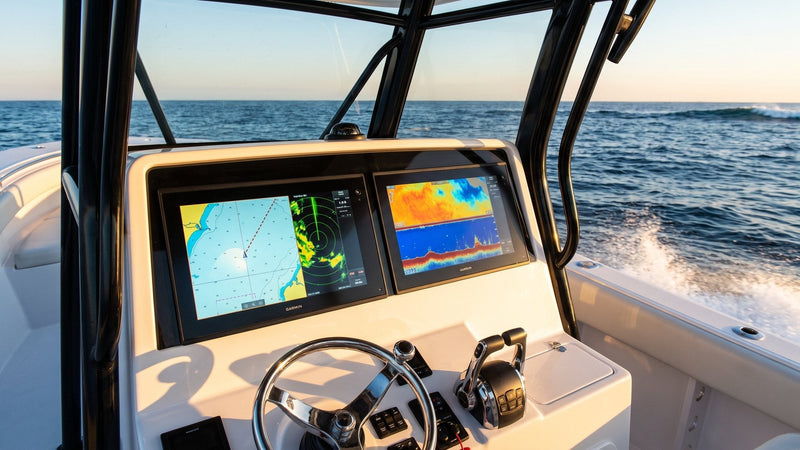
A 19-foot center console doesn't give you the dash real estate of a 35-foot sportfisher, and the helm on most sub-20 boats is already crowded with a wheel, throttle, switch panel, and a cup holder you fought hard to keep. So picking a chartplotter for a small boat isn't about buying the biggest screen with the most features. It's about getting a unit that fits the space you actually have, draws power your battery can spare, and shows you the chart and the bottom clearly enough that you can run inlets and find structure without squinting.
We rig a lot of small boats. Bay boats, aluminum jon boats, 17-foot Whalers, pontoon decks, tiller-steer skiffs. The mistake we see most often is someone buying a 12-inch glass-bridge display for a boat where a 7-inch keypad unit would have been faster to use, cheaper to install, and easier to read in the chop. Bigger isn't automatically better when your console is the size of a cooler lid.
This guide covers the chartplotter and combo units that actually make sense on a small boat in 2026 — what they cost, where they shine, and the real annoyances we've run into mounting and running them. If you want the full lineup across every boat size, start with our Best Marine Chartplotters of 2026 buyer's guide and come back here for the small-boat picks.
What "small boat" changes about the buying decision
Three things matter more on a sub-20 boat than they do on a big rig.
Screen size vs. console space. A 7-inch display is the sweet spot for most small boats. It's big enough to split a chart and sonar window and still read both, but small enough to flush-mount in a console without eating your whole dash. A 9-inch works on a roomier 18- to 20-footer with a proper console. Anything bigger and you're usually bracket-mounting it where it blocks sightlines or takes a beating. We get into the screen-size math in our chartplotter screen size guide, but for small boats: start at 7, justify your way up to 9, stop there.
Power draw. Small boats often run a single cranking battery, sometimes a modest dual setup. A 7-inch combo pulls roughly 0.7 to 1.5 amps depending on backlight and sonar load. That's nothing on a 24-foot boat with a house bank, but if you're running a tiller skiff off one battery and you like to sit and fish for six hours with the motor off, it adds up. Pick a unit with an efficient display and wire it to a fused circuit, not piggybacked onto your bilge pump line. We've seen that exact shortcut kill a battery on a slow troll.
Mounting reality. Flush mount looks clean but you need cut depth behind the console — often 3 to 4 inches of clearance for the unit body and the cable bend. A lot of small consoles don't have it. Bracket (gimbal) mounting is more forgiving and lets you tilt the screen out of glare, but it sticks up and can rattle loose on a rough day if you don't snug the knobs. Measure twice before you cut anything.
Our top picks for small boats in 2026
Garmin ECHOMAP UHD2 7" — best all-around small-boat combo
If someone walked into the shop with a 17- to 20-foot boat and no strong brand loyalty, this is the one we'd point at first. The Garmin ECHOMAP UHD2 7" runs about $899 for the 73cv (down imaging) and around $999 for the 74sv with the GT54 transducer that adds SideVü. The keypad-and-touchscreen hybrid is the right call on a small boat — when you're running 30 knots across a chop, mashing a physical button is a lot more reliable than trying to land a fingertip on a moving touch target.
It ships with Navionics+ coastal cartography for the contiguous U.S. and the Bahamas, which means you're not buying a chart card the day you unbox it. The 73cv covers the basics for under $800: GPS, traditional CHIRP sonar, ClearVü down imaging, and solid charts. We've run these on bay boats for two seasons with zero complaints beyond the obvious — the 7-inch screen is a 7-inch screen, and at high noon with the sun directly overhead you'll occasionally tilt your head to cut glare.
One honest gripe: the GT24 transducer that comes on the cheaper bundle is fine for down imaging but the cable is short, and on some transom layouts you'll want an extension. Plan for that.
Lowrance Elite FS 7 — best for the angler who wants live sonar later
The Lowrance Elite FS 7 runs around $949 with the Active Imaging 3-in-1 transducer, and the reason it earns a spot here is upgrade path. This is the small-boat combo that'll take an ActiveTarget 2 live sonar module down the road without you replacing the whole display. If you're a tournament-minded bass or inshore angler on a smaller boat now, planning to add forward-facing sonar next season, the Elite FS is the smart buy.
It runs C-MAP Contour+ mapping, networks over NMEA 2000, and the Active Imaging SideScan is genuinely good for the price — we've marked brush piles in 18 feet of stained water clearly enough to drop on them. The interface is a touch busier than Garmin's, and if you've never run a Lowrance the menu structure takes a weekend to learn. Worth it for the live-sonar headroom.
Lowrance HOOK Reveal 7 — best budget pick that still has charts
Not everyone needs SideScan and a NMEA 2000 backbone. If you've got a 16-foot aluminum boat, a single battery, and you mostly want to see the bottom and not run aground, the Lowrance HOOK Reveal 7 at about $596 (SplitShot, with CHIRP and DownScan) does the job for hundreds less. Autotuning sonar means you're not fiddling with sensitivity settings, which is exactly what a casual user wants.
The catch — and it's a real one — is that HOOK Reveal is a closed system. No NMEA 2000 networking, no live sonar upgrade, no radar overlay. What you buy is what you've got. For a lot of small-boat owners that's completely fine. Just know you're buying a finished product, not a platform.
Raymarine Element 7 HV — best sonar imaging in the small-boat class
The Raymarine Element 7 HV sits around $617 and its party trick is HyperVision — 1.2 MHz imaging sonar that produces sharper SideVision and DownVision than most of the field at this size. If your fishing is structure-heavy and you stare at imaging more than the chart, the Element's picture is the best in this group.
It's a keypad unit (no touchscreen), which some people love on a small boat for the same reason we like Garmin's hybrid — buttons don't care if your hands are wet. The LightHouse charts are clean. The downside is a smaller third-party app ecosystem than Garmin or Lowrance, and the quad-core processor, while quick, occasionally hiccups redrawing charts when you pan fast. Minor.
Simrad GO7 XSR — best if radar is in your future
Most small boats never get radar. But if you run a 19- to 20-foot center console offshore and think you might add a dome down the line, the Simrad GO7 XSR at roughly $949 is built for it — plug-and-play support for Simrad Halo pulse compression radar is baked in. It's a full touchscreen, which on a bigger small-boat console with a leaning post is more usable than on a tiller skiff. C-MAP charts, wireless phone mirroring, and a genuinely slick interface. For the radar-curious small-boat offshore crowd, this is the pick. If radar's not on your radar, you're paying for headroom you won't use.
Quick comparison
| Model | Price (2026 est.) | Screen | Touchscreen | Live sonar upgrade | NMEA 2000 | Best for |
|---|---|---|---|---|---|---|
| Garmin ECHOMAP UHD2 7" 73cv | ~$899 | 7" | Hybrid | No | Yes | All-around small boat |
| Garmin ECHOMAP UHD2 7" 74sv | ~$999 | 7" | Hybrid | No | Yes | Adds SideVü imaging |
| Lowrance Elite FS 7 | ~$949 | 7" | Yes | Yes (ActiveTarget 2) | Yes | Anglers wanting live sonar later |
| Lowrance HOOK Reveal 7 | ~$596 | 7" | Yes | No | No | Budget / simple setups |
| Raymarine Element 7 HV | ~$617 | 7" | No (keypad) | No | Yes | Best imaging picture |
| Simrad GO7 XSR | ~$949 | 7" | Yes | No | Yes | Radar-ready offshore |
Prices are 2026 estimates and shift with transducer and chart bundles. Check the live product pages for current pricing.
A quick word on the fishfinder-only trap
You'll see units like the Garmin Striker Vivid 7sv at around $449 and wonder why we didn't list it. Here's the deal: the Striker is a fishfinder with GPS, but it has no chart support. You get a blank GPS background and Quickdraw contours you map yourself — no coastal charts, no navigation aids, no inlets drawn for you. For pond-and-lake fishing where you already know the water, that's fine and a great value. For anyone running coastal water or needing actual navigation, it's not a chartplotter and shouldn't be on this list. Know which one you're buying.
How to choose: questions to ask yourself
How much console space do I really have? Measure your flush-mount cutout depth before anything else. If you don't have 3 to 4 inches of clearance behind the dash, you're bracket mounting, and that changes which units sit well.
Do I need charts, or just sonar? Coastal or inlet running means you need real cartography. Familiar inland lake only? You might save money with a fishfinder-GPS combo instead.
Will I ever add live sonar or radar? If yes, buy a platform (Elite FS for live sonar, GO7 XSR for radar). If no, a closed unit like the HOOK Reveal saves real money.
One battery or two? Single-battery boats should favor efficient displays and proper fused wiring. Don't skimp on the install.
Buttons or touchscreen? Small fast boats and wet hands favor keypad or hybrid units. Bigger small-boat consoles with a leaning post can run full touch comfortably.
Bottom line
For most people rigging a boat under 20 feet in 2026, the Garmin ECHOMAP UHD2 7" is the unit we'd put our own money on — it fits the console, reads well, comes with charts, and the hybrid keypad earns its keep the first time you run a chop. Step up to the Lowrance Elite FS 7 if forward-facing sonar is in your near future, drop down to the HOOK Reveal 7 if you want charts and sonar without the extras, and look at the Simrad GO7 XSR only if radar's genuinely on your list. The Raymarine Element 7 HV is the one to beat if imaging quality is what you care about most.
Whatever you pick, get the install right. A great chartplotter wired to a marginal circuit and mounted where the sun blinds it is a frustrating piece of gear. A modest one rigged properly is a joy.
👉 Shop All Chartplotters at NVN Marine →
Frequently Asked Questions
What size chartplotter is best for a boat under 20 feet?
A 7-inch display is the sweet spot for most small boats. It's large enough to split chart and sonar windows while still reading both clearly, and small enough to flush-mount without dominating a tight console. Step up to a 9-inch only if you've got a roomy 18- to 20-foot center console with a proper dash. Bigger displays usually have to be bracket-mounted on small boats, where they block sightlines and take more abuse.
Do I need a chartplotter or just a fish finder for a small boat?
If you run coastal water, inlets, or anywhere you need navigation aids and charts, you need a true chartplotter with cartography. If you fish only familiar inland lakes, a fishfinder-GPS combo like the Garmin Striker Vivid can save you money — but it has no real charts, just a blank GPS background. Match the tool to where you actually boat.
Can I flush-mount a chartplotter in a small boat console?
Sometimes. Flush mounting looks clean but requires roughly 3 to 4 inches of clearance behind the console for the unit body and cable bend. Many small consoles don't have it. Measure your cutout depth first. If clearance is tight, a bracket (gimbal) mount is more forgiving and lets you tilt the screen away from glare.
Will a 7-inch chartplotter drain my battery?
A 7-inch combo draws roughly 0.7 to 1.5 amps depending on backlight and sonar load — negligible on most boats. The risk is on single-battery small boats during long, motor-off fishing sessions. Wire the unit to its own fused circuit rather than piggybacking on another line, and you'll be fine.
Which small-boat chartplotter has the best sonar imaging?
The Raymarine Element 7 HV leads the small-boat class on imaging thanks to its 1.2 MHz HyperVision sonar, which produces noticeably sharper SideVision and DownVision than competitors at this screen size. The Lowrance Elite FS 7 with Active Imaging is a close second and adds a live-sonar upgrade path.