You've got a new fish finder. Maybe it's a Humminbird Solix, a Garmin GPSMAP, or a Lowrance HDS — doesn't matter. The box is on your workbench, and you're staring at the transducer trying to figure out where it goes. The manual says you have options. The internet gives you twelve conflicting opinions.
Here's the short answer: transom-mount for most recreational boats, through-hull for performance builds and serious offshore work. But that short answer skips a lot of important nuance, and making the wrong call costs you a day on the water plus a not-insignificant amount of fiberglass work.
We've mounted hundreds of transducers — on bass boats, center consoles, offshore walkarounds, sailboats, even a few pontoons that had no business being fished as hard as they were. This post walks through both mounting types honestly, including the failure modes most product pages won't tell you about. For a full overview of all transducer types available, start with our Marine Transducer Buyer's Guide.
What Is a Through-Hull Transducer?
A through-hull transducer passes through a hole drilled in the hull and is faired flush with the bottom of the boat. The transducer element is in direct, unobstructed contact with the water. No air gaps, no fiberglass in the way, no turbulence from mounting hardware.
The most common through-hull options we see are the Airmar B175H (~$395) for performance boats and the Airmar P319 (~$210) for mid-range applications. Both use a fairing block — a wedge of epoxy or specialized compound that levels out the transducer face relative to the water flow, so your readings aren't tilted at 3°.
What through-hull does really well: signal quality at speed. If you're running 35+ mph and need a clean bottom reading without dropout, a properly installed through-hull is the only reliable way to get it. We've tested setups where a transom-mount will completely lose bottom at 28 knots, while a through-hull on the same boat with the same sonar unit reads perfectly at 45. The physics aren't complicated — direct water contact means no signal loss from air entrainment or fiberglass interference.

Installation reality check: You're drilling a hole in the bottom of your boat. This requires a seacock, proper bedding compound (3M 5200 or 4200), and a correctly built fairing block. Professional installation typically runs $200–400 in labor. Done right, it lasts the life of the boat. Done wrong, you're dealing with a slow weep.
What Is a Transom-Mount Transducer?
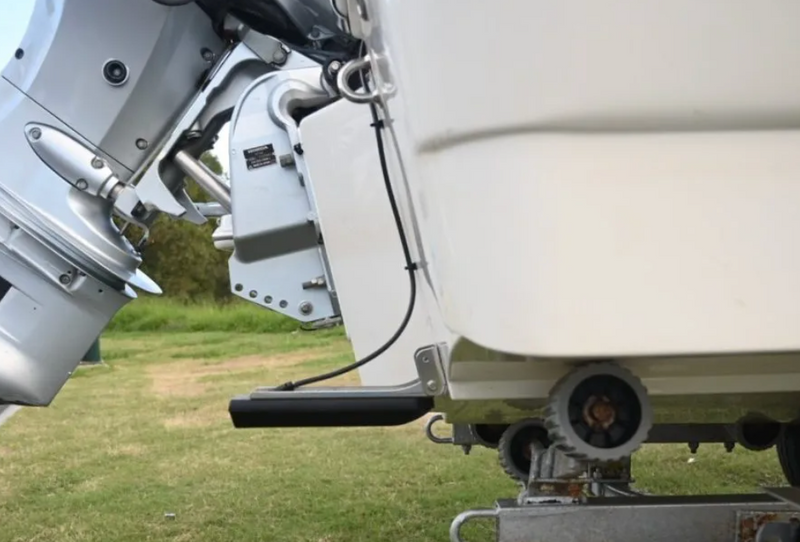
A transom-mount transducer bolts to the outside of the transom, just below the waterline, and hangs at a slight downward angle into the water. It's removable without any hull penetration, and most recreational fish finders ship with one in the box.
The Garmin GT52HW-TM (~$279) is the gold standard here for Garmin units — it handles CHIRP traditional sonar, CHIRP ClearVü, and CHIRP SideVü in one housing. The Lowrance ActiveImaging 3-in-1 (~$373) does the same for Lowrance/Simrad systems. Both are solid transducers that will outperform their predecessors by a wide margin.
The advantage is access and flexibility. You can adjust the angle without draining the bilge. You can swap it out in 20 minutes. If you upgrade your fish finder, replacing the transducer doesn't require touching the hull. For most freshwater fishing, bass anglers at speeds under 20 mph, and inshore saltwater work on flats boats and center consoles — transom-mount works well.
The limitation nobody in the product listing mentions: turbulence. At speed, the area just behind the transom gets messy. Water separates, air bubbles get dragged along the hull bottom, and they hit your transducer. Above roughly 25–30 mph on most boats, you'll see signal dropout or noisy readings on a transom-mount setup. The exact speed depends on your hull design, but nobody's escaping the physics.
There's also cavitation caused by the engine. Trim an outboard at the wrong angle, or run with too much negative trim, and you push turbulent water right into your transducer's face. We've seen anglers blame their sonar unit for "trash" readings when the actual fix was adjusting the outboard trim and repositioning the transducer bracket 4 inches to port, away from the prop wash.

Shoot-Through (In-Hull) Transducers: The Third Option
Worth mentioning because people ask: in-hull or shoot-through transducers mount inside the hull and transmit through the fiberglass. No holes drilled, completely protected from damage, works fine on solid fiberglass hulls.
The caveat is big: they only work on solid fiberglass. Foam-cored, balsa-cored, or composite hulls absorb signal. The Airmar SS264 is the benchmark here, and it's a good unit on the right hull. But we've had customers waste money because they didn't check whether their hull was solid glass first. Check before you buy.
Side-by-Side Comparison
| Feature | Through-Hull | Transom-Mount | In-Hull |
|---|---|---|---|
| Signal quality at speed (30+ mph) | ✅ Excellent | ⚠️ Degrades | ⚠️ Degrades |
| Installation complexity | High | Low | Medium |
| Hull penetration required | Yes | No | No |
| Performance under 20 mph | Excellent | Excellent | Good |
| CHIRP / SideVü / DownVü support | Depends on transducer | Wide selection | Limited |
| Removable / upgradeable | No (without repair) | Yes, easily | Yes (bracket mounts) |
| Works on cored hulls | Yes | Yes | No |
| Seacock required | Yes | No | No |
When to Choose a Through-Hull
Performance boats that regularly cruise at 30+ mph. If you're running offshore to the Gulf Stream or doing extended runs at speed, through-hull is the right call. The clean signal at high speed is worth the installation complexity.
Tournament anglers who need precision. When you're marking fish on structure and the difference between a clean reading and noise costs you a bag, through-hull gives you the clearest picture.
New builds. If a boat is getting a full electronics package installed, through-hull makes more sense during a refit than retrofitting an existing boat. Yards can glass the fitting in properly before the boat is finished.
Fiberglass single-skin hulls where professional installation is available. That last qualifier matters. If a shop is doing it right — fairing block, seacock, proper bedding compound — through-hull is excellent. If you're drilling the hole yourself with a hole saw and hoping the bedding holds, don't.
When to Choose Transom-Mount
Most recreational freshwater fishing. Bass anglers, walleye guys, crappie fishing on a jon boat — transom-mount does everything you need at the speeds you're running. The Garmin GT52HW-TM or the Humminbird XNT 9 HW T (~$95) will give you excellent images of structure, baitfish, and bottom composition.
Inshore saltwater anglers. Redfish, snook, trout — you're not running 40 mph. A transom-mount on a center console or flats boat works perfectly. The practical limit is around 20–25 mph for clean readings, and most inshore work doesn't exceed that.
DIY installs and budget builds. If you're adding a fish finder to a boat yourself and don't want to drill the hull, transom-mount is the obvious choice. Proper mounting takes about an hour with a drill, some self-tapping screws, and marine sealant.
Boats you might resell. No hull holes means the boat comes out of your ownership cleaner.
Failure Modes to Know
Through-hull failures:
- Improper fairing block alignment causes off-angle readings and misses bottom at speed. We've seen this on DIY jobs where the fairing block wasn't built up level.
- Bedding compound failure leads to seeping. Not dramatic, but preventable by using 3M 5200 (permanent) or 4200 (serviceable) properly.
- Seacock thread corrosion on older bronze fittings in saltwater. Inspect annually, grease the handle.
Transom-mount failures:
- Air entrainment and signal dropout above 25–30 mph on most hull designs.
- Bracket loosening over time from vibration. Check mounting screws every season and re-bed if needed.
- Too close to the engine: prop wash interference shows up as random noise during acceleration. Position the transducer at least 15 inches from the prop centerline.
- Bracket gets clipped on a sandbar or submerged stump. Transom-mount transducers are low-cost to replace.
Buying Guide: Questions to Ask Before You Commit
What's the top speed of your boat? Under 25 mph — transom-mount handles it. Over 35 mph regularly — strongly consider through-hull.
What are you fishing for? Offshore structure fishing for grouper and snapper benefits from clean imaging at speed. Inshore flats fishing? Transom-mount is fine.
Is your hull solid fiberglass? Determines whether in-hull is even an option.
Do you want professional installation or are you doing it yourself? Be honest. Through-hull done poorly is worse than transom-mount done well.
What transducer does your sonar unit prefer? Match the transducer to the head unit. The Garmin GT52HW-TM pairs specifically with Garmin's CHIRP SideVü and ClearVü systems. The Lowrance ActiveImaging 3-in-1 is built for Lowrance and Simrad fish finders. For pairing advice, see our guide on Garmin Livescope Plus setup.
Bottom Line
Transom-mount wins for most recreational boaters. The installation is simple, signal quality at typical fishing speeds is excellent, and the cost is a fraction of through-hull. If you're buying a Garmin, Humminbird, or Lowrance fish finder for freshwater or inshore use, mount the transducer on your transom, position it properly away from prop wash, and fish.
Through-hull is the right call when speed is part of your routine. Offshore captains, performance boaters, and anyone regularly running 30+ mph who wants uninterrupted sonar readings should budget for a professional through-hull installation. The Airmar B175H is the one we'd spec for that use case — broadband CHIRP, excellent at depth, built to last.
Whatever route you choose, don't cheap out on the transducer relative to your fish finder. A $1,200 sonar unit paired with a $60 transducer is like buying a high-end scope for a $100 rifle. Match the gear to the application.
Frequently Asked Questions
Can I use a through-hull transducer on a fiberglass boat with a balsa wood core?
Yes — but you need to carefully glass out the balsa in the area where you drill, replacing it with epoxy or solid fiberglass to prevent moisture infiltration into the core. It's more work than a solid-glass installation. Most professional yards do this routinely, but it adds cost and time. Don't skip this step — water in a balsa core is a structural problem, not just an electronics problem.
My transom-mount transducer reads perfectly at idle but loses bottom at speed. Is it defective?
Almost certainly not defective — this is the most common transom-mount complaint and it's a mounting issue, not a unit issue. Air bubbles off the hull are hitting the transducer face. Try adjusting the bracket angle slightly downward (aim for the transducer face parallel to water at running trim, not at rest), or reposition it further from the engine. Many anglers find moving it 6–8 inches toward the opposite side of the engine solves it.
Do I need a seacock for a through-hull transducer?
Yes, and we won't budge on this one. ABYC standards recommend seacocks on all through-hull fittings below the waterline. If the fitting fails or you need to pull the transducer for service, a seacock lets you close the hole. Without one, you're stuck hauling the boat. Ball-valve seacocks from Groco or Forespar run $50–120 and are worth every dollar.
What's the best through-hull transducer for a center console used for offshore fishing?
The Airmar B175H (around $395) is the one we'd spec for most offshore center consoles. It handles CHIRP from 130–210 kHz with a 16-degree beam angle — good depth penetration and enough resolution to pick out bottom structure offshore. It does require a 2-inch hull cutout and a proper fairing block installation.
Can I use a transom-mount transducer on a fiberglass boat with a sharp deadrise?
Yes, and sometimes it works better than on a flat-bottomed hull. A 20–24 degree deadrise naturally puts more water against the transom, which can actually reduce the turbulence problem at speed compared to flat-bottomed designs. The key is still mounting location — keep it away from the engine, strakes, and any hull vents that could introduce air.
How do I know if my hull is solid fiberglass or cored?
Tap the hull bottom with a knuckle. Solid glass sounds solid and relatively high-pitched. Cored hulls sound slightly hollow or dull. For a more definitive test, drill a small pilot hole in an inconspicuous area — solid glass produces uniform fiberglass dust; cored hulls will show a distinct inner material (balsa grain, foam cells, etc.) once you get through the outer skin. If you're unsure, ask your boat builder or a marine surveyor before committing to an in-hull mount.