By the NVN Marine Expert Team — Our team has spent 10+ years on the water installing, testing, and troubleshooting marine electronics from the Gulf Coast to the Great Lakes. We're authorized resellers for every brand we review, and we only recommend gear we'd trust on our own boats.
A radar dome that can pick out a kayaker at 80 feet in a rain squall used to cost open-array money. The Garmin GMR Fantom 18x changed that math. We've installed a dozen of these on center consoles and cruisers since the x-series launched, and at $2,199.99 it's the radar we recommend more than any other dome under $3,000. This Garmin GMR Fantom review covers what the 18x actually does on the water, where it falls short, and who should buy the 24x instead.
Quick context first. The Fantom 18x is a 50-watt solid-state pulse compression radar in an 18-inch dome. That 50W number matters because the original Fantom 18 shipped with 40W, and the x-series bump translated to noticeably better target separation past 8 nautical miles. Garmin rates it from 20 feet out to 48 nautical miles, and it talks to your chartplotter over a single Garmin Marine Network ethernet cable plus 12/24V power.
What Pulse Compression Actually Buys You
Traditional magnetron radars blast a short, powerful pulse — 4kW, sometimes 6kW — and listen for the echo. They work, but they need warm-up time, they chew power, and their magnetrons degrade over roughly 3,000–5,000 hours of transmit time.
Pulse compression flips the approach. The Fantom 18x transmits a longer, frequency-modulated chirp at much lower power, then uses signal processing to "compress" the return into a sharp target. The practical results we see on customer boats:
- Instant-on. No 90-second magnetron warm-up. Flip it on as you clear the no-wake zone.
- Target separation that embarrasses 4kW domes. Two boats running 60 feet apart at 2 nm show as two boats, not one blob.
- Power draw around 27W transmitting. A magnetron dome pulls 40W+ and hammers your house bank on an overnight drift.
The trade-off used to be range performance in rain. Early solid-state domes struggled to burn through heavy precipitation the way raw magnetron power could. Garmin's answer is the 50W output plus a dynamic sea filter that adjusts clutter rejection on the fly. In a June squall off Islamorada we held a channel marker at 4 nm through rain heavy enough that the hardtop sounded like a drum. That would have been marginal on the original 40W Fantom.
MotionScope: The Feature That Sells the Unit
MotionScope is Garmin's name for Doppler processing, and it's the single biggest reason to buy a Fantom over a non-Doppler dome. The radar reads the frequency shift of every return and colors targets by what they're doing: green for targets moving away, red for targets closing on you.
Anyone who has stared at a radar screen in fog trying to figure out which of nine blobs is the ferry actually bearing down on them understands instantly why this matters. The threats paint themselves red. You don't wait two sweeps to judge trails, you don't set up MARPA on everything — you just see it.
Two real-world notes from our installs. First, MotionScope picks up flocks of diving birds remarkably well, which offshore guys figure out fast (more on bird mode below). Second, Doppler shading works at the radar's full range, but the color coding is most useful inside 6 nm where collision decisions actually happen.
On-Water Performance
We ran a Fantom 18x head-to-head against a Raymarine Quantum 2 on two near-identical 26-foot center consoles last fall. Honest results:
Close range: The Fantom resolved a crab pot float at roughly 70 feet. The Quantum 2 saw it too, but the Fantom's return was tighter and easier to distinguish from sea clutter. Both embarrass any magnetron dome inside a quarter mile.
Mid range (2–8 nm): Dead even on big targets. The Fantom's 5.2° horizontal beamwidth paints slightly wider targets than an open array (no surprise — physics), but its target separation held two sportfish boats apart at 3.5 nm where older domes merged them.
Birds: The 18x has a dedicated bird gain mode, and it works. We've marked feeding frenzies at 3–4 nm consistently. Don't expect the 8 nm bird detection an open-array Fantom 54 delivers — the dome doesn't have the antenna length for it. For inshore and nearshore work, 3–4 nm of bird range finds fish.
Rotation speed: Up to 60 RPM at short range, which keeps the picture fluid when you're running an inlet at 30 knots. At longer ranges it drops to 24/48 RPM. The fast update inside half a mile is a genuine safety feature in crowded water, not a spec-sheet brag.
Where the Fantom 18x Falls Short
No balanced-for-the-sake-of-it padding here — these are real complaints.
The 48 nm range rating is optimistic for a dome this size. Rated range and useful range are different things; weather cells, yes, you'll see them at 30+ nm, but surface targets past about 16 nm are a stretch with 5.2° of beamwidth from a hardtop-height mount. If you regularly need to track ships at 20+ nm, you want an open array or at least the 24x.
It's Garmin-only. The Fantom speaks Garmin Marine Network, period. No NMEA 2000 radar overlay to a Simrad or Raymarine MFD, no workaround. If your helm runs anything other than a GPSMAP or compatible ECHOMAP Ultra, this radar is a non-starter. Plan the whole helm around one brand — we say this in every radar consult.
MARPA needs a heading sensor. Out of the box you get MotionScope and echo trails, but actual MARPA target tracking requires a 9-axis heading sensor on the network (figure another $200–$250 if you don't have one). Garmin doesn't hide this, but plenty of buyers discover it after the install.
The dome runs warm in standby. Minor, but worth knowing: unlike a magnetron unit that's truly idle in standby, the Fantom's electronics stay active. Standby draw is around 7W. Leave it in standby on a small battery bank overnight and you'll notice.
Fantom 18x vs 24x: Which Dome?
| Spec | GMR Fantom 18x | GMR Fantom 24x |
|---|---|---|
| Dome size | 18" | 24" |
| Output power | 50W | 50W |
| Horizontal beamwidth | 5.2° | 3.7° |
| Max range | 48 nm | 48 nm |
| Max rotation | 60 RPM | 60 RPM |
| MotionScope Doppler | Yes | Yes |
| Bird mode | Yes | Yes |
| Weight | ~15.4 lb | ~19 lb |
| Price (NVN, white) | $2,199.99 | $2,999.99 |
The honest answer: beamwidth is the whole decision. The 24x's 3.7° beam paints noticeably crisper targets past 6 nm and separates birds from boats better at distance. If you fish offshore past the 10 nm line or run at night in shipping lanes, spend the extra $800 on the Garmin GMR Fantom 24x. For bay boats, coastal cruisers, and anyone whose radar life happens inside 8 nm, the 18x does everything that matters and saves you money for charts.
Both come in white or black (18x black runs $2,199.99) — buy whichever matches your hardtop, the electronics are identical.
Installation Notes From Our Shop
Mounting is straightforward: four bolts on a standard 18" dome footprint, so it drops onto most existing radar mounts and hardtops without new holes. Two things bite first-time installers.
Cable run planning. The Fantom uses a single Garmin Marine Network cable plus power. The network cable ends in a bulky RJ45-style connector — drill your chase tube hole for the connector, not the cable. We use a 1¼" hole minimum. Pulling that connector through a packed rigging tube on a T-top is the worst 45 minutes of the job.
Power it from the helm bus, not the chartplotter circuit. The radar wants its own 5A breaker. We've chased two "random radar dropout" complaints that turned out to be radars daisy-chained onto an already-loaded accessory circuit sagging under load at startup.
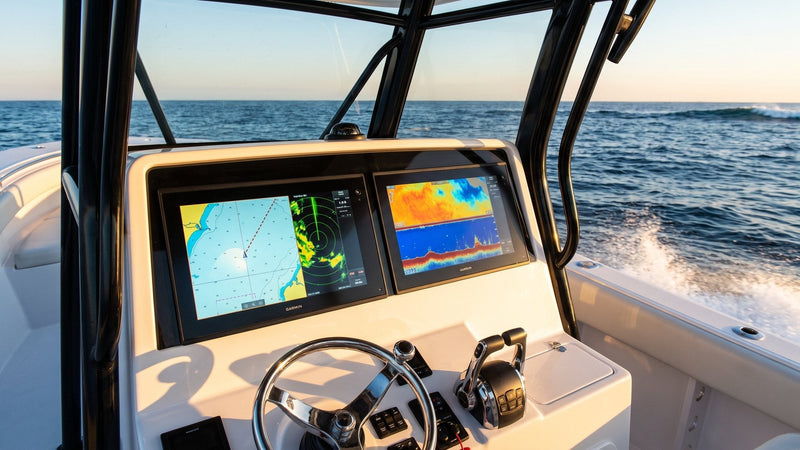
Pair it with a Garmin GPSMAP 943xsv or larger and setup takes ten minutes: the MFD finds the radome automatically, runs you through bearing alignment, and you're overlaying radar on the chart before lunch. If you're still planning the helm, our chartplotter buyer's guide covers which GPSMAP fits which boat.
How It Stacks Against the Competition
Against the Raymarine Quantum 2 ($2,584.99): the Quantum 2 has Doppler too, weighs less (11 lb), and can run on WiFi for dead-simple installs. But it's 20W CHIRP to the Fantom's 50W, its max range is 24 nm, and it tops out at 24 RPM. The Fantom is simply the stronger radar; the Quantum 2 wins on weight and on Raymarine helms.
Against the Simrad Halo 20+ (~$3,200): the Halo 20+ is the closest performance rival, with 60 RPM, Doppler (VelocityTrack), and dual-range. It's also several hundred dollars more, and in our side-by-sides the Fantom's bird mode is more sensitive.
For the full landscape including open arrays, see our best marine radar systems of 2026 guide
Should You Buy the Fantom 18x?
Buy it if you run a Garmin helm and want the best dome radar performance per dollar available in 2026. The 50W pulse compression, MotionScope Doppler, 60 RPM update rate, and working bird mode make it the most complete sub-$2,500 dome on the market, and it's not particularly close.
Skip it if your MFD isn't Garmin (no exceptions — it won't connect), if you need 20+ nm surface target tracking (get the 24x or an open array), or if every pound aloft matters on a small sailboat (the Quantum 2 saves 4.5 lb).
We've put these on everything from 22-foot bay boats to 38-foot express cruisers, and the complaint rate is about as low as marine electronics gets. Radar is the one piece of gear you buy hoping you never truly need it. This one earns its spot on the hardtop.
👉 Shop All Marine Radar at NVN Marine →
Questions about compatibility with your current helm? we answer the phone Mon–Fri 9am–5pm EST, and yes, an actual installer picks up.
Frequently Asked Questions
Is the Garmin GMR Fantom 18x compatible with non-Garmin chartplotters?
No. The Fantom 18x connects exclusively through the Garmin Marine Network and only displays on compatible Garmin GPSMAP and ECHOMAP Ultra units. If you run a Simrad, Raymarine, or Furuno helm, choose a radar from that brand's ecosystem instead.
What's the real-world range of the Fantom 18x?
It's rated to 48 nm, and you'll see weather cells at 30+ nm. For surface targets, expect reliable detection of boats and markers out to roughly 12–16 nm depending on mounting height and target size. Inside 8 nm, performance is outstanding for an 18-inch dome.
Does the GMR Fantom 18x detect birds?
Yes. It has a dedicated bird gain mode, and in our experience it reliably marks feeding flocks at 3–4 nautical miles. The larger open-array Fantom models see birds farther out, but 3–4 nm is genuinely useful for finding fish nearshore.
What's the difference between the Fantom 18x and the Fantom 24x?
Both are 50W with MotionScope Doppler and 60 RPM rotation. The 24x's larger antenna gives it a tighter 3.7° beamwidth versus 5.2° on the 18x, which means crisper target separation at longer ranges. The 18x costs $2,199.99 and the 24x runs $2,999.99 at NVN Marine.
Do I need a heading sensor for the Fantom 18x?
For basic radar, chart overlay, and MotionScope Doppler, no. For MARPA target tracking and accurate radar overlay while turning, yes — you'll want a 9-axis heading sensor on your NMEA 2000 network, typically a $200–$250 add-on.
How much power does the Fantom 18x draw?
Around 27W while transmitting and roughly 7W in standby on a 12V system — about half what a comparable 4kW magnetron dome consumes. It accepts 12V or 24V power and needs its own 5A circuit.