By the NVN Marine Expert Team — Our team has spent 10+ years on the water installing, testing, and troubleshooting marine electronics from the Gulf Coast to the Great Lakes. We’re authorized resellers for every brand we review, and we only recommend gear we’d trust on our own boats.
The VHF radio is the one piece of gear you can’t skip. Not the chartplotter, not the fish finder — the radio. When a thunderstorm builds faster than the forecast predicted or a swimmer is in distress 200 yards off your stern, that radio is the only thing between you and a very bad outcome.
Fixed-Mount or Handheld — Do You Need Both?
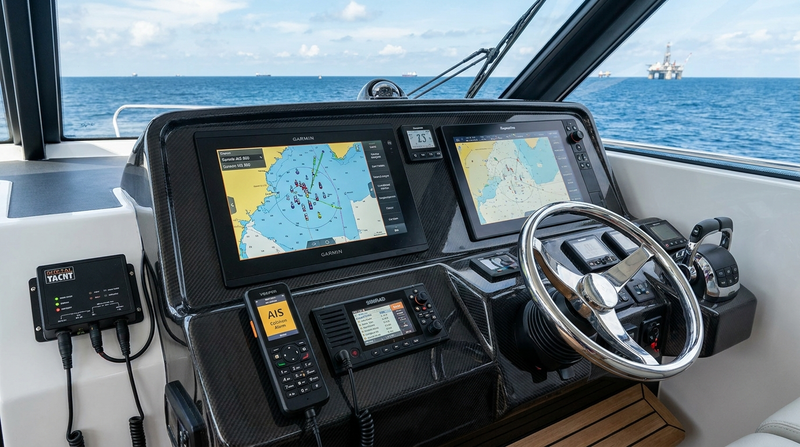
If you’re on a trailered boat under 22 feet doing day trips on inland lakes, a good handheld gets you 90% of the way there. Larger vessels, overnight runs, or offshore fishing: you want a fixed-mount as your primary and a handheld as your backup. The fixed-mount wins on transmit power (25W vs. 6W max for handhelds), antenna height advantage, and DSC reliability wired to your GPS via NMEA 2000.

Best Fixed-Mount VHF Radios
Standard Horizon GX1850G — $399.99
Our go-to recommendation for mid-size coastal cruisers and center consoles for the past two years. At 25W, Class D DSC, with an integrated GPS receiver and NMEA 2000 connectivity, it ticks every important box. The hailer/foghorn function is genuinely useful on boats without a dedicated horn. Setup takes under 30 minutes.
Best for: Center consoles, cruisers under 35 feet, coastal day boaters
Shop Standard Horizon GX1850G →
Icom IC-M510 — $799.95
If you’re doing offshore runs — even just 30–40 miles out — the IC-M510 is the radio we’d put on our own boat. The AquaQuake draining function vibrates the speaker membrane to clear standing water and maintain audio quality after spray hits the unit. It sounds like a gimmick. It isn’t. Active Noise Cancelling on both transmit and receive is real — at wide open throttle on a 300hp center console, the person on the other end can actually understand you.
Best for: Offshore fishermen, bluewater cruisers, consistently rough conditions
Best Handheld VHF Radios
Standard Horizon HX400 — $319.99
The HX400 floats. That’s the first thing. 5W (legal maximum for handhelds), DSC, JIS8 submersibility at 1.5 meters for 30 minutes, and 12+ hours of battery life on a single charge.
Best for: Day boaters, kayak anglers, backup radio on larger vessels
Icom IC-M37 — $199.95
The most waterproof handheld we’ve tested — IPX8 rated to 1.5 meters for 30 minutes, with a tough rubber over-mold that’s survived more drops than we’d like to admit. Charges via standard Micro-USB — you can top it off from a power bank on multiday trips. No integrated GPS, which limits it as an offshore backup. For inshore fishing where position accuracy in a distress call is less critical, it’s excellent.
Best for: Inshore anglers, kayakers, backup radio for protected waters
Quick Comparison Table
| Radio | Type | Power | GPS | Waterproof | Price |
|---|---|---|---|---|---|
| Standard Horizon GX1850G | Fixed | 25W | Built-in | IPX4 | ~$399 |
| Icom IC-M510 | Fixed | 25W | Built-in | IPX7 / AquaQuake | ~$799 |
| Standard Horizon HX400 | Handheld | 5W | No | JIS8 | ~$319 |
| Icom IC-M37 | Handheld | 6W | No | IPX8 | ~$199 |
The Bottom Line
For most boaters: Standard Horizon GX1850G as the primary fixed-mount paired with the Standard Horizon HX400 as the handheld backup. If you’re running offshore regularly, swap the GX1850G for the Icom IC-M510. What you shouldn’t do is skip the fixed-mount entirely because you have a nice handheld. Six watts looks fine until you’re 15 miles out.
Stay safe out there — get the right radio
Shop All VHF Radios at NVN Marine →