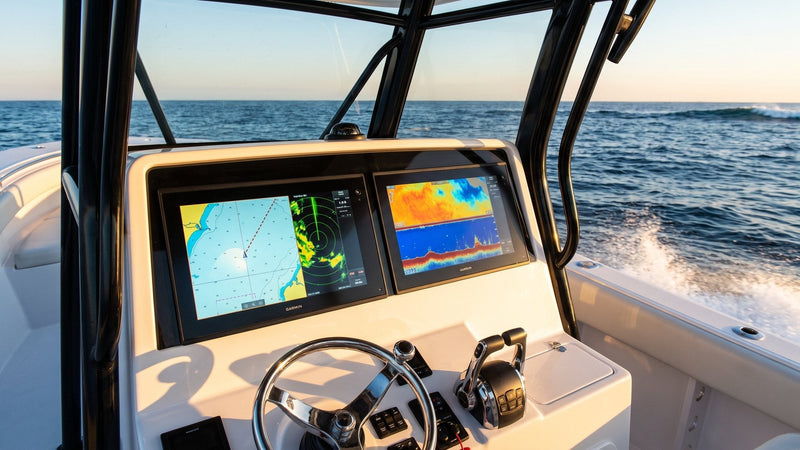
An AIS receiver will put a 1,000-foot container ship on your chartplotter from 15 miles out, with its name, speed, and closest point of approach. That ship's bridge crew, meanwhile, has no idea you exist.
That one-way street is the whole Class B AIS transponder vs receiver decision. A receiver lets you see. A transponder lets you see and be seen. The gap between them runs from about $100 to $1,200 depending on how you do it, and for plenty of boats the cheaper option really is enough. For others, it's the most important $900 on the helm.
We've wired both onto everything from 19-foot bay boats to 45-foot cruising sailboats. Here's how we decide which one a boat needs, and what we'd buy in 2026.
What a receiver does (and doesn't)
AIS (Automatic Identification System) is a VHF data network. Every equipped vessel broadcasts position, course, speed, and identity on two channels, 161.975 and 162.025 MHz. A receiver listens to both, decodes the messages, and passes targets to your plotter over NMEA 2000, NMEA 0183, USB, or Wi-Fi.
A receiver never keys up. It needs no MMSI, no license, and no GPS of its own, and it draws well under a watt. It will show you every commercial ship over 65 feet in US waters, because 33 CFR 164.46 requires them to carry AIS.
What it won't do is put you on anyone else's screen. Not the ship, not the tug pushing barges around the bend, not your buddy boat.
There are two ways to get receive-only AIS aboard.
A standalone receiver. The em-trak R300 at $299.97 and the Digital Yacht AIS100 at $270.99 are the budget entries. The Digital Yacht AISnode at $548.99 plugs straight into an NMEA 2000 backbone, and the Furuno FA40 at $745.00 is what we put on Furuno helms.
A VHF radio with AIS receive built in. This is where most boats should start. The Standard Horizon GX2400B Matrix is $499.99 with AIS receive, internal GPS, NMEA 2000, and a 30W hailer. The Garmin VHF 215 AIS is $596.99, just $145 over the non-AIS VHF 215. The Icom M605 with AIS is $1,049.95, a $200 step over the standard M605. We broke down that lineup in our Icom M510 vs M605 comparison.
One antenna, one power feed, one GPS. If you're replacing an old VHF anyway, AIS receive costs $150 to $200 extra. Hard to argue with.
What a Class B transponder adds
A transponder is a receiver plus a transmitter plus its own GPS. It broadcasts your boat's name, MMSI, position, course, speed, and dimensions. Ships, other AIS boats, the Coast Guard, and shore-based tracking networks all see you.
Class B is the recreational standard. Class A is what ships carry: 12.5 watts, reports every 2 to 10 seconds underway, and north of $2,000. Unless you're commercial, skip it.
The part that confuses people is that Class B comes in two flavors, and they are not equal.
CSTDMA: 2 watts, the original Class B
CSTDMA (Carrier-Sense Time Division Multiple Access) units transmit at 2 watts. Before each transmission the unit listens for a free time slot. If the channel is busy, it waits. It reports every 30 seconds above 2 knots and every 3 minutes below.
That politeness is the weakness. In New York Harbor, the Houston Ship Channel, or the approaches to Port Everglades, the channel is busy constantly, and a 2W unit can go a minute or more between successful reports. At 25 knots, 30 seconds is already 420 yards between updates. A skipped slot doubles it.
In our experience, a 2W unit with a decent antenna at 10 to 12 feet gets picked up reliably out to about 5 to 7 nautical miles.
SOTDMA: 5 watts, "Class B+" or "Class B/SO"
SOTDMA (Self-Organizing Time Division Multiple Access) is the slot-reservation scheme Class A uses. The unit books its future transmission slots instead of waiting for gaps, so it doesn't get squeezed out in traffic. It transmits at 5 watts and reports faster as you go faster:
| Speed | SOTDMA Class B report interval |
|---|---|
| Under 2 knots | 3 minutes |
| 2–14 knots | 30 seconds |
| 14–23 knots | 15 seconds |
| Over 23 knots | 5 seconds |
For a center console at 30 knots, that's the difference between a ship's officer watching you move in 80-yard hops versus quarter-mile jumps. Range roughly doubles too; we typically see 8 to 12 nautical miles from the same antenna height.
If you're buying a transponder in 2026, buy SOTDMA. The price gap is down to $100 to $250 on most brands, and it's the better radio in every way that matters.
The hardware we'd buy
2W CSTDMA transponders
The cheapest way to transmit is the Digital Yacht AIT1500 at $395.99 with built-in GPS. For a lake boat that wants to show up for friends, it's a reasonable entry. The em-trak B921 at $630.63 is the more polished 2W unit, and the Raymarine AIS700 at $996.99 is 2W with a built-in splitter for SeaTalkng helms.
Honestly, we'd skip 2W at these prices. The em-trak 5W unit below is only $127 more than the B921.
5W SOTDMA transponders
- em-trak B951 Class B, 5W SOTDMA $757.35
- Digital Yacht AIT2500 Class B+ 5W SOTDMA with GPS $799.99
- Garmin AIS 800 Class B/SO blackbox $873.99
- SI-TEX MDA-5H 5W SOTDMA with built-in splitter $927.99
- em-trak B953 5W SOTDMA with VHF antenna splitter $946.44
- Digital Yacht AIT5000 Class B+ 5W with splitter and Wi-Fi $1,093.99
- Vesper Cortex M1 SOTDMA smartAIS with remote monitoring $1,449.99
The em-trak B951 is the value pick: NMEA 2000 and 0183, solid build, and the least expensive 5W unit we'd trust. The B953 adds a splitter for about $190, less than a good external splitter costs on its own.
The Garmin AIS 800 is the obvious choice on a Garmin helm. Targets, CPA alarms, and filtering all behave cleanly on GPSMAP displays. Plan on a dedicated AIS antenna or an external splitter.
The Vesper Cortex is a different animal. Vesper, now a Garmin brand, built its name on smartAIS, which filters alarms by situation so a moored boat drifting within a mile doesn't set you off. The M1 adds a built-in splitter plus cellular remote monitoring for anchor watch, bilge, and battery voltage. The Cortex V1 at $1,999.99 folds the VHF radio in too. Remote monitoring needs a subscription after the trial. For a cruising sailboat on a mooring for weeks at a time, worth it. For a trailered center console, overkill.
Antennas and splitters: where installs go wrong

A transponder needs a VHF antenna. You either mount a second one or share your radio's antenna through a splitter.
A dedicated antenna is the most reliable path. The Shakespeare 8-foot AIS Galaxy at $270.99 is tuned for the AIS band. Keep it at least 3 feet vertically from the VHF antenna. We've fixed more than one "AIS range is terrible" complaint just by getting two whips off the same crossbar.
A splitter is cleaner on a small boat, with one hard rule: it must be an active splitter rated for transponders. The Digital Yacht SPL1500 at $330.99 and SPL2000 at $353.99 handle both transmitters. A passive unit like the Shakespeare 5257-S at $69.99 is fine for an AIS receiver (and it'll feed your FM stereo too). Hook a transponder to it and you'll damage something.
When a splitter fails, it takes your VHF down with it. Buy a good one, or buy a transponder with one built in.
Transponders also need their own GPS antenna, and most include one. The Digital Yacht MA800 is $108.39 as a replacement. Your chartplotter's GPS can't substitute; the standard requires an independent position source.
MMSI programming: don't skip this step
A transponder won't transmit without an MMSI (Maritime Mobile Service Identity), the nine-digit number that identifies your boat. If you have a DSC VHF, use the same number. One boat, one MMSI. Our DSC VHF radio explainer covers where it comes from.
In the US, domestic-only boats can get a free MMSI from BoatUS, Sea Tow, or America's Boating Club. Heading to the Bahamas or Canada? You need an FCC ship station license, and the MMSI comes with it. The free numbers aren't valid internationally, which catches Florida boaters every winter.
Here's the failure mode. Most Class B units accept the MMSI once. Fat-finger a digit and you're broadcasting someone else's identity, and fixing it usually means a dealer reset or a trip back to the manufacturer. Some units ship for dealer programming, which is why the Navico NAIS-500 with GPS antenna ($899.99) lists "Includes Programming." Check the number against your paperwork before you hit confirm.
How they compare
| AIS receiver | VHF with AIS receive | Class B CSTDMA (2W) | Class B SOTDMA (5W) | |
|---|---|---|---|---|
| Others see you | No | No | Yes | Yes |
| Transmit power | — | — | 2 W | 5 W |
| Report interval over 23 kn | — | — | 30 sec | 5 sec |
| Busy-channel behavior | — | — | Yields, can skip | Reserves slots |
| Typical range others see you | — | — | 5–7 nm | 8–12 nm |
| MMSI required | No | Yes (for DSC) | Yes | Yes |
| Example at NVN | em-trak R300, $299.97 | Standard Horizon GX2400B, $499.99 | Digital Yacht AIT1500, $395.99 | em-trak B951, $757.35 |
| NVN price range | $270–$745 | $500–$1,050 | $396–$997 | $757–$1,450 |
When receive-only is enough
A lot of boats don't need to transmit, and we'll say so.
If you fish inshore, run in daylight, stay out of shipping channels, and mostly want to know what the tug is doing around the next bend, a VHF with AIS receive is plenty. You get CPA alarms on the plotter, and you avoid the thing that matters most: getting in a ship's way. A ship with a 2-mile stopping distance can't maneuver for you anyway. Staying clear is on you whether they see you or not.
Same goes for inland lakes with no commercial traffic.
When you should transmit
- You run offshore, at night, or in fog more than a handful of times a season.
- You cross or run alongside shipping lanes.
- You sail. A fiberglass sailboat is a lousy radar target, and in a sea a ship's radar may not paint you at all.
- You cruise to the Bahamas or make long passages.
Tournament anglers, note: most transponders have a silent mode that stops transmitting but keeps receiving. Go dark on your spot, switch back on for the run home after sunset.
None of this replaces radar and a lookout. Busy ships sometimes filter Class B targets off their displays, and plenty of boats carry nothing. More on that in AIS vs radar for collision avoidance, and the full lineup is in our best AIS transponders of 2026 guide.
Four questions that decide it
Does anything bigger than you share your water? If not, receive-only on a VHF is the smart money.
Do you run after dark or in reduced visibility? Then be seen. Buy SOTDMA.
What's on your helm? On NMEA 2000, most of these units plug into a T-connector; our NMEA 2000 network setup guide covers power and termination. On Garmin, the AIS 800 is the path of least friction.
Room for a second antenna? If not, buy a transponder with an integrated splitter.
The bottom line
For most boats that leave protected water, buy the em-trak B953 5W SOTDMA with built-in splitter at $946.44. Five watts, reserved slots in traffic, it shares your existing VHF whip, and it costs less than a comparable transponder plus a quality splitter. On a Garmin helm with room for a second antenna, swap in the AIS 800.
If you're a daylight inshore boater with an aging VHF, replace it with a Standard Horizon GX2400B at $499.99 and call it done.
The one move we'd steer you away from is a 2W transponder bought to save $130. If you're going to transmit, transmit properly.
Want help with the antenna layout or getting the MMSI right the first time? Call us at (212) 688-0550 before you order.
Authorized AIS dealer · Same-day shipping before 3 PM EST · Full manufacturer warranty
Shop All AIS Systems at NVN Marine →Frequently asked questions
Can other boats see me if I only have an AIS receiver?
No. A receiver only listens. It shows nearby AIS-equipped vessels on your chartplotter but never transmits, so your boat won't appear on anyone else's display. To be seen, you need a Class B or Class A AIS transponder.
What's the difference between SOTDMA and CSTDMA Class B AIS?
CSTDMA units transmit at 2 watts, report every 30 seconds underway, and wait for a free slot, so they can get skipped in busy harbors. SOTDMA units transmit at 5 watts, reserve their own slots like Class A, and report as often as every 5 seconds above 23 knots.
Do I need an MMSI number for an AIS transponder?
Yes. A transponder won't transmit without one. Use the same MMSI as your DSC VHF. US boats staying in domestic waters can get one free from BoatUS, Sea Tow, or America's Boating Club; boats traveling abroad need an FCC ship station license.
Can my VHF radio and AIS transponder share one antenna?
Yes, through an active splitter rated for transponders, such as the Digital Yacht SPL1500, or a transponder with a built-in splitter. Passive splitters made for AIS receivers won't work. A dedicated AIS antenna mounted 3 feet vertically from the VHF antenna is the alternative.
Is a VHF radio with built-in AIS receive good enough?
For many inshore, daylight boaters, yes. It shows every AIS target on your plotter for roughly $150 to $200 over the non-AIS radio. It doesn't transmit, though, so if you run at night, in fog, or near shipping lanes, add a transponder.
Does a Class B AIS transponder replace radar?
No. AIS only shows vessels carrying AIS, and busy ships sometimes filter Class B targets off their displays. Radar shows everything that reflects a signal, including unequipped boats, land, and weather. Use them together.