The boat that would have heard your mayday in July is shrink-wrapped in a yard by October.
That's the part of fall boating nobody plans for. The safety net you leaned on all summer (other boats within shouting distance, a busy Channel 16) has gone home. Water that was 75°F on Labor Day is in the mid-50s by late October across much of the Northeast. You are not swimming to anything in that.
So here's our marine safety electronics checklist, built the way we outfit customer boats: by where the boat goes, not by what's on sale. We've installed every category below. Prices are current NVN Marine prices as of fall 2026.
How to use this checklist
Find your tier, then buy everything in it and every tier below.
- Tier 1: Inshore and lakes. Within sight of shore, usually under 3 miles out.
- Tier 2: Coastal. 3 to 20 miles off, inlet runs, fog, night running.
- Tier 3: Offshore. Beyond 20 miles, canyon trips, overnight passages.
Electronics are the second line of defense. A life jacket on your body is the first.
Tier 1: What every boat needs, even on a lake
A fixed-mount DSC VHF with your MMSI programmed
A VHF isn't legally required on a U.S. recreational boat under 65.6 feet. It should be. A cell phone calls one person; Channel 16 reaches the Coast Guard and every boat in range.
The feature that matters is DSC (Digital Selective Calling). Hold the red button for five seconds and the radio sends a digital mayday with your identity and position to every DSC radio and Coast Guard station in range. That only works if a 9-digit MMSI (Maritime Mobile Service Identity) is programmed in and the radio has a GPS position. We still see radios come in for service with no MMSI entered. BoatUS or Sea Tow will issue a free U.S.-only MMSI in about ten minutes. Our DSC VHF radio explainer has details.
- Icom M330 Compact VHF with built-in GPS $222.99
- Standard Horizon GX2400B Matrix VHF with AIS, GPS and 30W hailer $499.99
We put the M330 with internal GPS on most small boats. Built-in GPS means the distress call carries a position even when the chartplotter feed is dead or miswired, which we find constantly. On a bigger helm, the GX2400B is the best value in fixed VHF right now: AIS receive built in for under $500. Installing it yourself? Our marine VHF installation guide covers antenna height and coax, which matter more than the radio.
A handheld VHF with DSC and GPS
The fixed radio dies with the boat's electrical system. A floating handheld is your backup and abandon-ship radio.
- Standard Horizon HX890NB 6W handheld, Class H DSC, GPS $279.99
- Icom M94D handheld VHF with AIS receiver and DSC $399.99
The HX890 floats and has a real GPS. The M94D adds an AIS receiver, a ship-traffic display you can take into a life raft. Expect 3 to 5 miles boat-to-boat from deck level. More options in our best marine VHF radios of 2026 roundup.
Navigation lights that actually work
Legally required from sunset to sunrise and in restricted visibility, and the item we most often find broken. On a power boat under 12 meters, sidelights must be visible at 1 mile and the masthead or all-round white at 2 miles.
Fall is when this bites: sunset in New York is around 6:15 PM by mid-October. Corroded bayonet sockets are the number-one failure. Sealed LED fixtures like the Attwood LightArmor sidelight ($39.99 per side) end that problem. For kayaks and jon boats, the Attwood PaddleSport portable nav light kit is $39.99.
A bilge high-water alarm
When the pump's float switch sticks or the pump seizes, water rises silently. A high-water alarm is a second sensor a few inches above the pump's float that screams when water reaches it. It's the cheapest item here and has saved more boats than anything else.
Give the alarm its own fused circuit that stays live with the house switch off; we've found alarms sharing the pump's breaker.
A CO detector if there's a cabin
Cabin, cuddy, or camper canvas that zips shut? You need a marine-rated carbon monoxide detector, and ABYC standard A-24 calls for one in enclosed accommodation spaces. Generator exhaust and the "station wagon effect" that pulls fumes over the transom at slow speed put CO where people sleep, and closed-up fall cabins make it worse.
- Safe-T-Alert 62 Series 12V CO alarm $54.99
- Fireboy-Xintex CMD6-MD-R 12/24V CO alarm with relay $125.99
CO sensors wear out in 5 to 7 years, so check your date stamp. The Fireboy's relay can kick on a blower or shut down a generator, which is worth the extra $71 on any boat with a genset.

Tier 2: Coastal boats add these
A PLB on the person, before an EPIRB on the boat
Both beacons transmit GPS position on 406 MHz to the Cospas-Sarsat satellite system. A PLB (Personal Locator Beacon) is registered to a person, small enough to wear on a PFD, activated by hand, and must run at least 24 hours. An EPIRB (Emergency Position-Indicating Radio Beacon) is registered to a boat, runs at least 48 hours, floats upright, and in Category I form releases and activates itself when the boat sinks.
Our opinion: for coastal boats, a PLB on the body beats an EPIRB at the helm. The common coastal emergency isn't sinking; it's one person going over the side. An EPIRB in a bracket does nothing for them.
- Ocean Signal rescueME PLB1 personal locator beacon $399.95
- ACR ResQLink 400 / ResQLink View not currently stocked at NVN; roughly $300–$420 street
Register whichever you buy with NOAA SARSAT (free, online, renew every two years). An unregistered beacon still transmits, but the Coast Guard gets a hex code instead of your name and an emergency contact who can say "he left at 5 AM for the canyon." That phone call shrinks the search box.
AIS, at least receive
AIS (Automatic Identification System) puts ships and many other boats on your chartplotter with name, course, speed, and closest point of approach. Receive-only is the floor. A Class B transponder, so ships see you too, is better.
Bought the GX2400B above? You already have AIS receive. Busy harbors justify a 5-watt SOTDMA unit like the em-trak B953 ($946.44). Our best AIS transponders of 2026 roundup compares the field.
A backup GPS that isn't your phone
Every coastal boat should be able to lose its main display and still know where it is. The Garmin GPSMAP 79s handheld GPS ($272.99) floats and runs on two AAs. Phones fail when wet and cold (we've watched one drop from 40% to dead in 20 minutes in a raw October northwesterly).
Tier 3: Offshore adds these
A Category I EPIRB, in addition to the PLBs
Offshore, you want a beacon that goes off without anyone touching it. Category I units sit in a hydrostatic release that frees the beacon at roughly 1.5 to 4 meters of depth.
- Ocean Signal rescueME EPIRB2 Cat II with RLS & NFC $598.99
- Ocean Signal SafeSea EPIRB1 Pro float-free Category 1 $789.95
- Ocean Signal rescueME EPIRB3 Category 2 with AIS $899.95
Manual Category II suits a center console where a float-free unit would pin itself under a hardtop. Otherwise, go Cat I. RLS (Return Link Service) is worth paying for: Galileo-equipped units with RLS light an indicator when your alert has been received. An AIS-equipped beacon like the EPIRB3 also shows up on nearby plotters, which helps rescuers in the last mile. We covered the Ocean Signal EPIRB1 Pro when it launched.
An AIS MOB beacon on every PFD
A PLB brings the Coast Guard, often in hours. An AIS MOB beacon brings your own boat back in minutes. When it hits the water (automatically, when fitted inside an auto-inflating life jacket), it transmits the person's GPS position on AIS, and every AIS plotter within roughly 4 to 5 nautical miles shows a MOB target. Including yours.
Program the MOB1 with your MMSI and it also sends a DSC alert to your own VHF, so the radio alarms even if nobody's watching the plotter. OLAS tags sound an alarm and mark the position when a tagged crew member drops out of range, a cheaper way to cover a whole crew.
This is where fall water changes the math. In 55°F water, cold shock hits in the first minute and useful movement lasts roughly 10 minutes. The MOB beacon closes the gap the PLB can't.
Radar
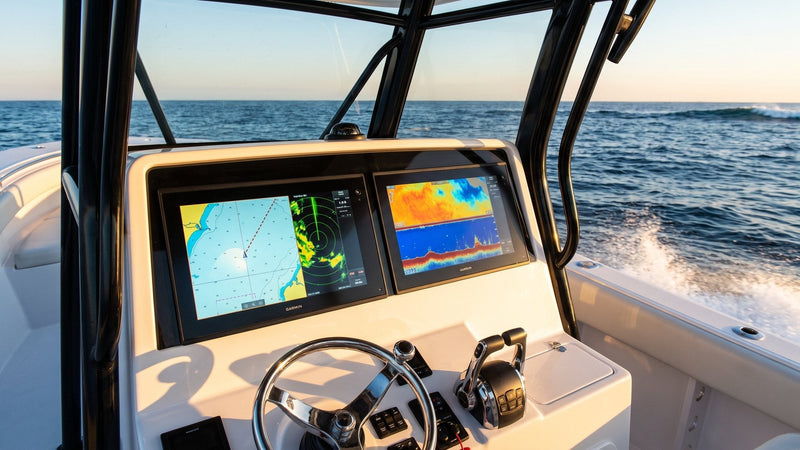
AIS only shows boats that transmit. Radar shows the lobster boat without AIS, the squall line, and the breakwater in fall fog.
- Garmin GMR Fantom 18x dome radar $2,199.99
- Raymarine Quantum 2 Q24D Doppler radar with 15M cables $2,684.99
Match your chartplotter brand. Read AIS vs radar for collision avoidance before deciding you only need one, and our best marine radar of 2026 guide for the rest of the lineup.
A satellite messenger and electronic flares
The Coast Guard's Rescue 21 VHF network reaches about 20 nautical miles off most of the coast. Past that, your VHF talks to other boats, not to shore. The Garmin inReach Mini 2 ($349.99, subscription required) adds two-way satellite texting and an SOS button. It supplements a 406 MHz beacon; it doesn't replace one.
The Ocean Signal rescueME EDF1 electronic flare ($137.99) runs for hours instead of minutes. A Coast Guard-approved electronic signal covers the night requirement only, so keep a day signal like an orange distress flag aboard.
The whole checklist at a glance
| Item | Tier 1: Inshore/lake | Tier 2: Coastal | Tier 3: Offshore | NVN price |
|---|---|---|---|---|
| Fixed DSC VHF + MMSI + GPS | Yes | Yes | Yes | $222.99–$499.99 |
| Handheld VHF with DSC/GPS | Yes | Yes | Yes | $279.99–$399.99 |
| Working nav lights | Yes | Yes | Yes | $39.99 per fixture |
| Bilge high-water alarm | Yes | Yes | Yes | $69.99–$77.59 |
| CO detector (cabin boats) | Yes | Yes | Yes | $54.99–$125.99 |
| PLB per person on deck | Recommended | Yes | Yes | $399.95 |
| AIS (receive or Class B) | Optional | Yes | Class B | $299.97–$946.44 |
| Backup handheld GPS | Optional | Yes | Yes | $272.99 |
| Category I EPIRB | No | Recommended | Yes | $598.99–$899.95 |
| AIS MOB beacon per PFD | No | Recommended | Yes | $384.95 |
| Radar | No | Recommended | Yes | $2,199.99–$2,684.99 |
| Satellite messenger | No | Optional | Yes | $349.99 + plan |
| Electronic flare | Optional | Yes | Yes | $137.99 |
Four questions to answer before you spend a dollar
Is your MMSI actually in the radio? Go look under the DSC or setup menu. If it's blank, fix that first. It's free.
Does the radio show a GPS position? No lat/long on the screen means your DSC mayday says who you are but not where.
Who goes on deck alone? They need a beacon on their body.
When did you last check dates? Beacons have a self-test button and a battery expiry on the label. CO alarms have an end-of-life date. Do all of it in one afternoon.
The bottom line
If you only do three things before the season's done: program your MMSI into a GPS-equipped DSC VHF like the Icom M330 with GPS ($222.99), put an Ocean Signal PLB1 ($399.95) on whoever fishes alone, and wire in a Maretron BHW100 high-water alarm ($69.99). That's under $700, and it covers the three emergencies we see most: nobody hears you, someone goes over, and the boat quietly fills up.
Running offshore this fall? The rescueME EPIRB3 with AIS plus a MOB1 in every life jacket is what we'd want on our own boats when the water is 55°F and the canyon is empty.
Not sure what fits your boat? Call us at (212) 688-0550. We'll tell you what you can skip, too.
Authorized ACR, Ocean Signal, Icom & Standard Horizon dealer · Same-day shipping before 3 PM EST · Full manufacturer warranty
Shop All Marine Safety Gear at NVN Marine →Frequently asked questions
Is a VHF radio required on a recreational boat?
Not for U.S. recreational boats under 65.6 feet (20 meters). If you carry one, you're expected to monitor Channel 16 while underway. We still consider a DSC VHF with an MMSI the most important safety electronics on any boat.
What's the difference between an EPIRB and a PLB?
Both transmit on 406 MHz to the Cospas-Sarsat satellite system with GPS position. A PLB is registered to a person, worn on the body, activated by hand, and runs at least 24 hours. An EPIRB is registered to a boat, floats upright, runs at least 48 hours, and a Category I EPIRB deploys and activates automatically if the boat sinks.
Do I need to register my EPIRB or PLB?
Yes. Registration with NOAA SARSAT is free, done online, and renewed every two years. Unregistered beacons still transmit, but rescuers get no name or emergency contact.
How do I get an MMSI number for my VHF radio?
If you only boat in U.S. waters, BoatUS and Sea Tow issue free MMSI numbers online in minutes. If you travel to foreign ports, including Canada or the Bahamas, you need an FCC ship station license, which assigns an MMSI.
Is an AIS MOB beacon a replacement for a PLB?
No. An AIS MOB beacon shows your position to AIS-equipped boats within roughly 4 to 5 nautical miles. It doesn't alert the Coast Guard through the satellite system. A PLB does. Offshore crews should carry both.
Can a Garmin inReach replace an EPIRB?
We don't recommend it. An inReach routes SOS over Iridium to a private response center and needs an active subscription. A 406 MHz EPIRB or PLB feeds the government Cospas-Sarsat system with no subscription and is built to survive immersion. Carry the inReach for messaging and the beacon for life-threatening emergencies.