By the NVN Marine Expert Team — Our team has spent 10+ years on the water installing, testing, and troubleshooting marine electronics from the Gulf Coast to the Great Lakes. We're authorized resellers for every brand we review, and we only recommend gear we'd trust on our own boats.
Picture this. You're 14 miles offshore in patchy fog off Montauk, the kind that drops visibility to maybe a quarter mile and then lifts just enough to make you doubt what you saw. Your radar paints a target dead ahead at 1.8 nautical miles. Is it moving? Toward you? Away? Crossing? Staring at a blip and guessing is how close calls happen. This is exactly the problem MARPA was built to solve, and once you've used it in real weather, you stop thinking of it as a luxury feature.
MARPA stands for Mini Automatic Radar Plotting Aid. It's the recreational-grade cousin of the full ARPA systems required on commercial ships over 10,000 gross tons. You tag a radar contact, and the system does the math — calculates that target's course, speed, closest point of approach (CPA), and time to closest point of approach (TCPA). Instead of a blob on a screen, you get a vector arrow and a readout telling you whether that boat is going to pass safely or put you on a collision line.
Most modern radar-capable chartplotters include MARPA at no extra cost. The catch is that it only works when you give it the data it needs, and a surprising number of boaters either don't know it's there or have it set up wrong. Let's fix that.
What MARPA Actually Does Under the Hood
Here's the part nobody explains well. MARPA doesn't track targets by magic. It needs two pieces of information your radar alone can't provide: your boat's heading and, ideally, your speed over ground.
Radar measures range and bearing relative to your boat. That's it. If your boat yaws 20 degrees while sitting in a swell, every target on screen appears to swing 20 degrees too — even if nothing actually moved. To calculate a target's true course over ground, MARPA has to subtract your own motion from what the radar sees. That requires a heading sensor feeding real-time compass data into the network, usually a fluxgate or solid-state electronic compass on NMEA 2000 or NMEA 0183.
This is the single most common reason MARPA "doesn't work." People buy a radar, mount it, wire it to the chartplotter, and assume tracking will just happen. Then they tag a target and get a wildly wandering vector or an error message. Nine times out of ten the heading sensor is missing or the data isn't reaching the display. A standalone GPS COG (course over ground) reading is not the same thing — GPS tells you which way you're traveling, not which way the bow is pointing. At anchor or drifting beam-to, those can differ by 90 degrees.
Once heading is flowing, here's the sequence. You move the cursor over a contact and hit "Acquire Target." The system watches that blip across several radar sweeps — usually 30 seconds to a minute of observation — building a motion history. It then draws a vector line showing where the target is headed and how fast. Extend that vector, extend your own course line, and the geometry tells you if and where the paths intersect.
The numbers that matter:
- CPA (Closest Point of Approach) — the minimum distance the target will pass from you if both boats hold course and speed. A CPA of 0.05 nm means you're going to get uncomfortably close.
- TCPA (Time to Closest Point of Approach) — how many minutes until that closest pass. A TCPA of 4 minutes with a tight CPA means you need to act now.
- Target course and speed — the contact's actual track over ground, not relative to you.
Set a CPA alarm at, say, 0.25 nm and a TCPA alarm at 6 minutes, and the radar will shout at you before a tracked target becomes a problem. That's the whole point. You don't have to babysit the screen.
Why It Matters More Than People Think
We've heard the argument: "I've got AIS, I don't need MARPA." That's a dangerous half-truth, and it's worth unpacking because it gets people hurt.
AIS only shows you boats that are transmitting AIS. Commercial ships, sure. That 22-foot center console running across your bow at 30 knots with no transponder? Invisible to AIS. The sailboat with a receive-only AIS setup? Invisible. A semi-submerged container, a channel marker, a rain squall? AIS sees none of it. Radar sees all of it, and MARPA tracks any of it you tag. We dug into this distinction in our breakdown of AIS vs Radar for Collision Avoidance, and the short version is that they're complements, not substitutes. AIS gives you identity and intent on cooperative targets. MARPA gives you motion on everything else.
There's also the simple matter of confidence. Reading raw radar takes skill but even a sharp operator can misjudge a slow-closing target at night. MARPA removes the guesswork. The system tells you in plain numbers whether to alter course. In a crossing situation under the COLREGS, knowing the other vessel's true course helps you make the legally correct maneuver instead of a panicked one.
Honestly, for anyone who runs offshore, fishes structure in fog, or transits busy inlets at night, MARPA is the feature that earns its keep faster than almost anything else on the helm.
What You Need to Run MARPA
Let's be specific, because "MARPA-capable" gets thrown around loosely.
You need three things working together: a radar scanner, a compatible display that supports MARPA, and a heading sensor. Speed input (from GPS or a paddlewheel) sharpens the calculation but heading is the non-negotiable piece.
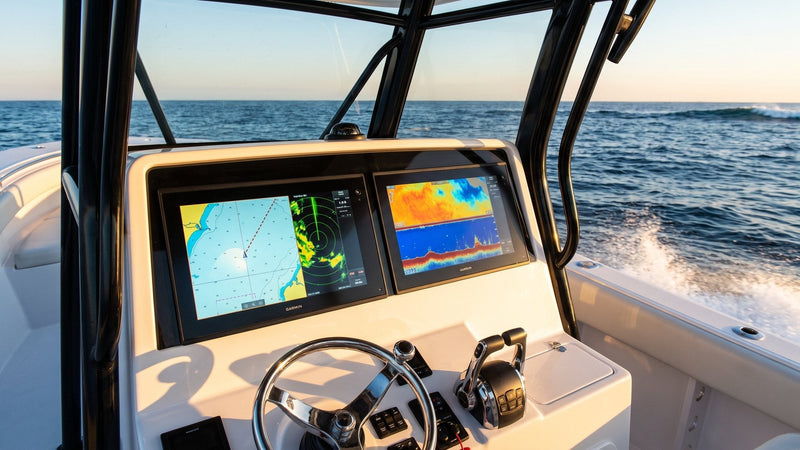
The good news is that most solid-state radars sold today pair with displays that include MARPA. Doppler-equipped radars take it a step further. Units like the Simrad Halo series, Garmin Fantom, and Raymarine Quantum 2 use Doppler processing to instantly color-code targets — approaching contacts show one color, stationary or receding ones another — before you even tag them. That's not technically MARPA (it's a separate Doppler feature), but it works alongside MARPA beautifully. The Doppler coloring tells you at a glance which targets are worth acquiring, then MARPA gives you the hard numbers on the ones that matter.
Here's how the common platforms stack up.
| Platform | MARPA Targets | Heading Source | Doppler Assist | Notes |
|---|---|---|---|---|
| Raymarine Axiom + Quantum 2 | Up to 25 | EV-1/EV-2 or external compass | Yes (True/Relative) | WiFi or cable; easiest plug-and-play |
| Simrad NSS evo3S + Halo20+ | Up to 20 | Precision-9 / compass on N2K | Yes (VelocityTrack) | Excellent target separation |
| Garmin GPSMAP + Fantom 18x | Up to 30 | Garmin heading sensor on N2K | Yes (MotionScope) | Highest tracked-target count |
| Furuno + DRS radar | Up to 30 (ARPA) | SC heading sensor | Varies by model | Closest to true commercial ARPA |
Those tracked-target counts matter more in crowded water than you'd guess. Run an inlet on a Saturday in July and you can easily have a dozen contacts worth watching. A system that caps at 10 fills up fast.
Setting It Up So It Actually Works
A few field notes from rigging these on real boats, not from a manual.
Get the heading sensor location right. Mount your electronic compass away from speakers, large DC motors, autopilot drive units, and steel. We've seen a fluxgate compass installed six inches from a stereo subwoofer throw target vectors off by 15 degrees — and the owner spent a weekend blaming the radar. On a center console, low and central, near the boat's fore-and-aft centerline, is usually your best bet. Calibrate it by running slow figure-eights per the manufacturer's procedure after install.
Confirm the data is on the network. On NMEA 2000, the chartplotter should list the heading sensor as an active device. If you tag a target and the vector jumps around erratically while you're holding a steady course, your heading data is either missing, noisy, or lagging.
Don't over-acquire. MARPA divides processing across every tracked target. Tag the three or four contacts that actually concern you, not every gull and lobster buoy. Overloading the tracker makes all your vectors less reliable.
Give it time to settle. A freshly acquired target needs 30–60 seconds of clean sweeps before its vector means anything. Acquire early, while the contact is still well off, rather than waiting until it's close.
Mind the heading-sensor failure mode. If your compass drops offline mid-run, MARPA goes with it, and on some displays the tracked vectors freeze in place rather than disappearing — which can look like valid data. Know what a heading-loss alarm looks like on your specific unit so you're not trusting a ghost.
Buying Guide: Questions Worth Asking
Before you spend money trying to get reliable target tracking, run through these.
Do I already have a heading sensor? If your boat has an autopilot, you very likely do, and it may already be feeding the network. Check before buying another. If you don't, budget $300–$600 for a quality solid-state heading sensor — it's the cheapest, highest-impact part of the whole setup.
Is my radar Doppler-equipped? If you're buying new, get Doppler. The instant approaching/receding coloring genuinely changes how fast you read a busy screen, and it pairs with MARPA rather than replacing it.
How many targets do I realistically need to track? Inshore day boater? Ten is plenty. Offshore in shipping lanes or running crowded inlets at night? Lean toward a 20–30 target platform.
Will it talk to my existing electronics? Raymarine radars want Raymarine displays, Simrad/B&G/Lowrance share the Navico ecosystem, and Garmin is its own world. Mixing brands across the radar-to-display link rarely ends well. We walk through ecosystem matching in our Best Marine Radar Systems of 2026 buyer's guide.
Dome or open array? That's a separate decision driven by boat size and range needs but it doesn't change MARPA capability. Both support it. If you're shopping complete systems, the Simrad NSS12 evo3S+ Halo20+bundle is a strong out-of-the-box Doppler-plus-MARPA package.
The Bottom Line
MARPA isn't the flashiest feature on a modern helm, and it never makes the marketing headline. But it's the one that quietly does the work that matters most: turning ambiguous blobs into clear answers about whether the boat near you is a problem. If you run in fog, at night, or anywhere with real traffic, set it up properly — heading sensor included — and learn to trust the CPA and TCPA readouts. The first time it alarms on a target you hadn't even noticed, you'll understand why we put it near the top of the list for anyone heading offshore.
If your current radar is older, non-Doppler, or simply not pulling its weight on target tracking, it might be time to upgrade. A Doppler radar paired with a MARPA-capable display and a properly mounted heading sensor is one of the most meaningful safety investments you can make on a boat.
👉 Shop All Marine Radar at NVN Marine →
Frequently Asked Questions
What does MARPA stand for and what does it do?
MARPA stands for Mini Automatic Radar Plotting Aid. It's a radar feature that tracks tagged targets and automatically calculates each one's course, speed, closest point of approach (CPA), and time to closest point of approach (TCPA), so you can tell at a glance whether a contact is on a collision course with you.
Do I need a heading sensor to use MARPA?
Yes. MARPA requires real-time heading data to subtract your own boat's motion from what the radar sees. A GPS course-over-ground reading is not a substitute, because it tells you your direction of travel, not where your bow is pointing. Without a dedicated electronic compass or heading sensor on the network, MARPA either won't function or will produce unreliable target vectors.
Is MARPA the same as AIS?
No. AIS only shows vessels that are actively transmitting an AIS signal, mostly commercial ships and some larger recreational boats. MARPA tracks any radar target you tag, including boats with no transponder, buoys, and other hazards. They work best together — AIS for identity and intent, MARPA for motion on everything else.
How many targets can MARPA track at once?
It depends on the system. Most recreational platforms track between 10 and 30 targets simultaneously. Raymarine Axiom systems handle up to 25, Simrad up to 20, and Garmin GPSMAP units up to 30. Tracking fewer, more relevant targets generally gives more reliable vectors than maxing out the tracker.
Why is my MARPA vector jumping around or inaccurate?
The usual culprit is heading data — either a missing heading sensor, a compass mounted too close to magnetic interference (speakers, motors, steel), or a poor data connection on the network. Recalibrate the compass, relocate it away from interference, and confirm the chartplotter sees it as an active device. Also give each new target 30–60 seconds to build a stable track before trusting its vector.
Does MARPA work with Doppler radar coloring?
Yes, and they complement each other. Doppler features like Simrad VelocityTrack, Garmin MotionScope, and Raymarine Doppler instantly color-code approaching versus receding targets so you can spot which contacts matter. MARPA then provides the precise CPA and TCPA numbers on the specific targets you choose to acquire.
NVN Marine is an authorized reseller for Raymarine, Simrad, Garmin, Furuno, and every brand we review. Questions about matching a radar to your boat? Our team has rigged these systems on everything from 19-foot bay boats to 50-foot sportfishers — reach out before you buy.