The first salmon we ever caught on a downrigger came on a flat, gray morning on Lake Ontario when the surface bite had been dead for two hours. We dropped a spoon to 62 feet, clipped it into the release, and ten minutes later the rod loaded up so hard the tip nearly buried in the gunwale. That's the whole pitch for downrigger fishing in one sentence: fish are almost always somewhere in the water column, and a downrigger is the only tool that puts your lure at exactly that depth and keeps it there.
If you've been marking fish at 40 feet and catching nothing on flat lines, this is the gear that fixes it. Learning how to use a downrigger isn't complicated, but there's a real difference between bolting one to the gunwale and actually understanding how to read your graph, set your release tension, and run gear at the right depth and distance. This guide walks through the whole thing the way we'd explain it standing on the dock — the setup, the technique, the mistakes that cost you fish, and the gear we trust to do it.
What a Downrigger Actually Does
A downrigger is a winch with a long boom that lowers a heavy lead ball — usually 8 to 12 pounds for salmon and trout — straight down on a thin stainless cable. Your fishing line clips to that cable (or to the ball) with a release clip. When a fish hits, the line pops free of the clip and you fight the fish on your rod, with no extra weight attached.
The magic is depth control. A flat line dragged behind the boat might run 10 feet down at trolling speed, and you have no real way to know. A downrigger puts your spoon at 55 feet because you set the counter to 55 feet. When the sonar shows a band of lake trout stacked at 70 to 80 feet, you can put a lure right in their faces and leave it there for the length of a pass.
That precision is why every serious salmon and trout troller on the Great Lakes runs them. It's also why kokanee and deep summer trout anglers out West swear by them once the fish drop below thermocline.
The Gear You Need to Start
You can overspend on this, so here's the honest short list.
A downrigger itself. For most freshwater salmon and trout fishing, a single electric unit per side of the boat is the standard setup, though plenty of people start with one manual unit and add from there. We'll get into specific models below.
A downrigger weight (the "ball"). For salmon and trout trolling, a 10-pound ball is the sweet spot. It tracks straight at 2 to 3 mph and minimizes blowback — the angle the cable takes behind the boat as water pushes against it. Drop to 8 pounds for shallow, slow kokanee work; bump to 12 or 15 pounds if you fish fast (over 3 mph) or in current.
Release clips. This is where people get tripped up. The release is the little clip that holds your fishing line to the cable and lets go on a strike. Pinch-pad releases are the most forgiving and let you dial tension. Stacker releases let you run a second rod off the same cable at a shallower depth.
Heavy monofilament leader off the reel. Run 15- to 20-pound mono as your main line or top shot. Mono grips the release better than braid and has stretch, which matters when a king inhales a spoon at 2.5 mph. Braid is too slick and too unforgiving for the release — it'll false-release in chop and pull out of the clip.
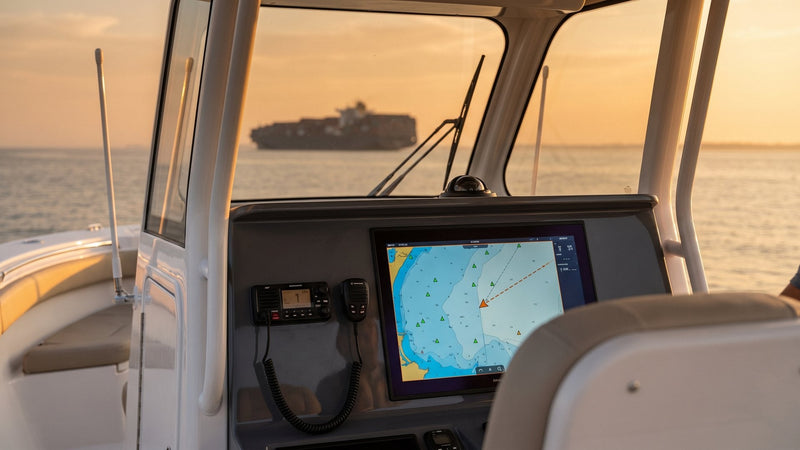
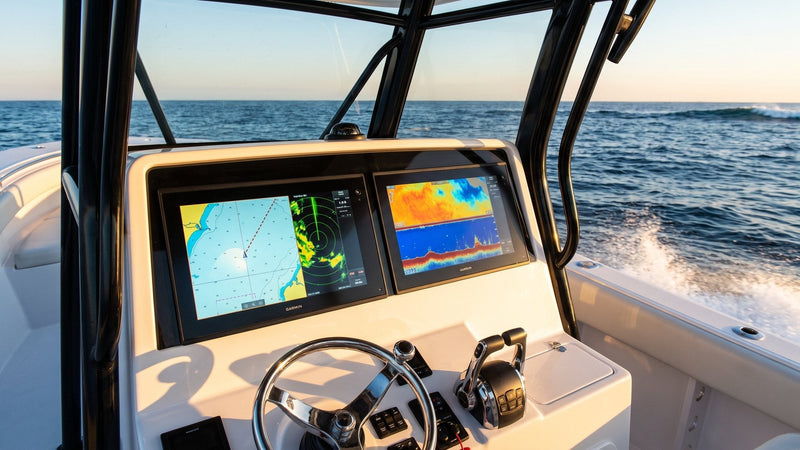
A fish finder you trust. We'll say it plainly: downrigger fishing without good sonar is half-blind. You need to see the fish, see your thermocline, and ideally see your downrigger ball on the screen so you know exactly where your lure is relative to the fish. A quality marine fish finder is the single biggest upgrade most downrigger anglers can make.
Setting Up a Downrigger Step by Step
Here's the actual sequence we run, start to finish.
- Mount the downrigger solid. The transom or gunwale gun-mount has to be through-bolted with a backing plate. A 12-pound ball plus blowback load plus a fighting fish puts real strain on the base. We've seen swivel bases tear out of fiberglass that was only screwed, not bolted. Don't be that boat.
- Set your trolling speed first, then drop. Get the boat tracking at your target speed — 2.0 to 2.5 mph over ground is a good salmon starting point — before you lower anything. Trolling speed changes how your lure swims and how much the cable blows back.
- Let your lure out behind the ball. Free-spool your fishing reel and let the lure run back the right distance behind the downrigger ball. For spoons, 25 to 40 feet back is typical. For a flasher/fly or dodger setup, shorten it to 15 to 25 feet so the flasher's action transfers to the fly. Spookier fish in clear water want a longer lead.
- Clip the line into the release. Pinch your fishing line into the release jaws per the clip's directions, then position the release on the cable (right at the ball for a single rod, or higher up for a stacker).
- Lower with thumb pressure on the reel. As the ball descends, keep light thumb pressure on your spinning reel spool so the lure pays out at the same rate the ball drops. Too little pressure and you'll have a belly of slack line to crank up when you hit depth. Too much and you risk loading the rod hard enough to snap a tip. The line going down should stay just barely taut.
- Stop at depth and set the rod. Watch the three-digit counter and stop the ball a few feet above the fish you're marking. Fish look up, not down, so you want your lure at or slightly above their level. Put the rod in the holder and crank until it bows into a deep arc against the release. That bend is your strike indicator — when the line pops, the rod snaps straight and you know you're on.
Reading Depth: Where the Fish Actually Are
A downrigger is only as smart as the angler reading the graph. Three things to watch.
The thermocline. In summer, salmon and trout stack near the thermocline — the band where warm surface water meets cold deep water. On most sonar units it shows as a fuzzy horizontal line, often 30 to 60 feet down depending on the lake and season. Fish hold there because it's where comfortable temperature meets oxygen and bait. Put your gear at or just above that band.
Bait balls and arches. Tight balls of bait with bigger arches near them are exactly what you're hunting. Set a rod 3 to 5 feet above the marks.
Your ball on the screen. Higher-end units will show your downrigger weight as a distinct mark. When you can see your ball and the fish on the same screen, you stop guessing. If your transducer is mounted poorly or underpowered, you won't get that clarity — which is one more reason transducer quality matters as much as the head unit. (We get into that in our marine transducer buyer's guide.)
Release Tension: The Setting That Wins or Loses Days
If we could fix one thing on most anglers' boats, it'd be release tension.
Set it too light and every wave, every speed-up, every weed bumps your line out of the clip — you spend the day reeling up empty gear and missing fish you never knew bit. Set it too heavy and a light-biting kokanee or a lazy summer brown taps the spoon, never trips the release, and swims off while your rod sits dead in the holder.
The fix is to match tension to the fish. For aggressive kings and coho, run firmer tension so chop and current don't false-release. For trout, kokanee, and any finicky bite, back it way off until a moderate pull pops it clean. Test it by hand at the surface before you drop — pull on the line and feel where it releases. You want it to let go at roughly the force of a real strike, not a sneeze and not a deadlift.
Wind and waves change this all day. In a 2-foot chop, you'll need more tension than on dead-calm water just to stop the boat's pitch from popping the clip. Adjust as conditions change. It's the single most active thing you do while trolling.
Single Rod, Stacking, and Running a Spread
Once you're comfortable, you can fish more lines off each downrigger.
Stacking means clipping a second rod onto the same cable above the first — say, one lure at 60 feet and a stacker at 40 feet. It doubles your coverage of the water column on one downrigger. Use a dedicated stacker release for the upper line.
Most boats run two downriggers, one per corner, set at different depths to find the strike zone fast. Once a depth produces, match the other rigger to it. Watch your boat's turning radius — on a turn, the inside downrigger slows and drops deeper while the outside one speeds up and rises, which is often exactly when you get bit. Lazy anglers troll dead straight; good ones troll lazy S-curves on purpose.
Choosing Your Downrigger: Manual vs Electric
Here's how we'd point you, by how you actually fish.
If you fish shallow, slow, and occasionally — small inland lakes for trout and kokanee, water under 60 feet — a manual downrigger is honestly all you need. The Cannon Easi-Troll ST manual downrigger and the compact Cannon Mini-Troll crank up a 10-pound ball without much fuss and cost a fraction of an electric. The tradeoff is real, though: cranking a 12-pound ball up from 90 feet by hand, ten times a morning, gets old fast.
If you fish deep, often, or for a living, go electric. The retrieval speed alone — pulling a ball up at 250 feet per minute instead of grinding a handle — changes your day. The Cannon MAG 10 STX electric downrigger is the workhorse we recommend most: stainless spool, three-digit counter, Auto-Up that stops the ball at the waterline, and Positive Ion Control. For tournament anglers and serious Great Lakes crews, the Cannon Optimum 10 BT adds Bluetooth, depth-cycling that automatically yo-yos the ball to trigger strikes, and network integration with compatible fish finders. It's the most capable rig Cannon builds.
We broke the full lineup down in our Best Downriggers of 2026 buyer's guide
Quick Comparison: Cannon Downriggers for Salmon & Trout
| Model | Type | Boom | Max Speed / Retrieval | Best For | Est. 2026 Price |
|---|---|---|---|---|---|
| Mini-Troll | Manual | 19" | Hand crank | Small boats, shallow trout | ~$111.99 |
| Easi-Troll ST | Manual | 24" | 1.5:1 hand crank | Inland lakes, kokanee, beginners | ~$238.99 |
| MAG 5 ST | Electric | 24" fixed | 250 ft/min | Mid-size boats, occasional deep | ~$549.99 |
| MAG 10 STX | Electric | 24"–53" telescoping | 250 ft/min | Great Lakes salmon, all-around | ~$625.99 |
| Optimum 10 BT | Electric | 24"–53" telescoping | 250 ft/min, depth-cycling | Tournament, deep, networked boats | ~$1,359.99 |
| Optimum 10 TS BT | Electric | 24"–53" telescoping | 250 ft/min, depth-cycling | Hardcore tournament crews | ~$1,599.99 |
Prices are 2026 estimates and move with the season — check current pricing on the product pages.
A Few Questions Worth Asking Before You Buy
How deep do you actually fish? If you're rarely past 50 feet, you don't need a flagship electric. If you're chasing summer kings at 90-plus, manual cranking will wear you out.
How many lines do you want in the water? More downriggers and stackers mean more rods, which means more electric units and more boom clearance to keep cables from tangling on turns.
What's your boat's power situation? Electric downriggers pull real amperage on retrieval. Make sure your battery and wiring can handle one or two of them plus your electronics. Run them off a dedicated circuit, not piggybacked on your sonar.
Do you already have good sonar? If not, fix that first. A $700 downrigger over a weak fish finder is backwards. See the lure, see the fish, then place one on the other.
The Bottom Line
Downrigger fishing isn't about owning the fanciest winch. It's about reading your graph, putting your lure a few feet above the fish, and dialing release tension so the clip pops on a strike and holds in the chop. Get those three right and you'll out-fish boats running twice your gear.
For most salmon and trout anglers stepping up from flat lines, the Cannon MAG 10 STX hits the rare balance of price, durability, and features that actually catch fish — it's the one we'd put on our own transom. If you fish small water and want to keep it simple, start with a manual Easi-Troll and a 10-pound ball, and add electric later when your back starts voting for it.
👉 Shop All Cannon Downriggers at NVN Marine →
Frequently Asked Questions
What size downrigger weight should I use for salmon and trout?
A 10-pound ball is the all-around sweet spot for salmon and trout trolling. It tracks straight at 2 to 3 mph and keeps cable blowback manageable. Drop to 8 pounds for slow, shallow kokanee fishing, and step up to 12 or 15 pounds if you troll faster than 3 mph or fight strong current, since heavier weights reduce blowback and keep your depth reading accurate.
How far behind the downrigger ball should my lure be?
For spoons, run 25 to 40 feet of lead between the ball and the lure. For flasher/fly or dodger setups, shorten it to 15 to 25 feet so the attractor's action carries to the fly. Clearer water and spookier fish call for a longer lead; stained water and aggressive fish let you fish tighter to the ball.
What line should I use with a downrigger release?
Use 15- to 20-pound monofilament as your main line or top shot. Mono grips the release clip far better than braid and its stretch cushions hard strikes. Braid is too slick and tends to false-release in chop or pull free of the clip, so avoid running it straight into the release.
How do I set my release clip tension?
Match tension to the fish and conditions. Run firmer tension for aggressive salmon and in rough water so waves and current don't trip the clip; back it off to light tension for kokanee, trout, and any finicky bite. Test by hand before dropping — the line should pop free at roughly the force of a real strike, not at the slightest tap and not only under heavy load.
Can I run two rods on one downrigger?
Yes — it's called stacking. Clip your first rod near the ball, then add a stacker release higher on the cable for a second rod at a shallower depth. One downrigger at, say, 60 and 40 feet covers two depths at once. Use a dedicated stacker release and watch your spacing so the lures don't tangle on turns.
Do I really need a fish finder to use a downrigger?
Practically, yes. A downrigger lets you fish an exact depth, but without sonar you're guessing which depth holds fish. Good sonar shows you the thermocline, the bait, the fish, and on better units your downrigger ball itself — so you can set your lure a few feet above the marks. Pairing a downrigger with a quality fish finder is what turns precise depth control into actual hookups.